IRA Tax Credits in 2026: What's Left and What's Gone
Who This Is For
Homeowners comparing quotes, running payback math, or deciding whether solar belongs in a larger home energy plan.
You’ll Leave With
- What Was the Inflation Reduction Act?
- What Changed: The One Big Beautiful Bill
- Credit Expiration Timeline
- Credit-by-Credit Breakdown
Best Next Step
Keep moving instead of starting over
When you finish this article, use the next guide below to compare options or validate your plan.
See what to ask installers→IRA Tax Credits in 2026: What's Left and What's Gone
This article contains affiliate links. We may earn a commission at no extra cost to you if you purchase through these links.
The Inflation Reduction Act was supposed to be a decade-long engine for clean energy adoption in America. Signed in August 2022, it created the most generous package of consumer clean energy tax credits the country had ever seen: 30 percent off solar installations, up to $7,500 for a new electric vehicle, thousands for heat pumps and insulation, and much more. Those credits were designed to last through the early 2030s.
Then the One Big Beautiful Bill Act changed everything.
Signed into law on July 4, 2025, the OBBBA (Public Law 119-21) accelerated the termination of nearly every consumer-facing IRA clean energy tax credit. If you are shopping for solar panels, an electric vehicle, a heat pump, or a home battery in 2026, the incentive landscape looks dramatically different from just a year ago.
This guide walks you through exactly what happened, what is still available, and how to make the most of the incentives that remain. We will cover each credit individually, explain the carryforward rules that could still save you thousands, and lay out a concrete action plan based on your situation. If you are specifically interested in solar incentives, our detailed breakdown of solar incentives and tax credits in 2026 covers that topic in depth.
What Was the Inflation Reduction Act?
The Inflation Reduction Act, signed August 16, 2022, allocated roughly $369 billion toward energy security and climate change provisions. For everyday consumers, the headline features were straightforward: generous tax credits that made clean energy upgrades significantly more affordable.
The IRA created or expanded credits across virtually every category of residential clean energy. Solar panels, battery storage, heat pumps, insulation, electric vehicles, EV chargers, geothermal systems, and energy-efficient windows and doors all qualified for substantial federal tax credits. The goal was to accelerate adoption by reducing the upfront cost barrier that prevents most households from making the switch.
For roughly three years, the program worked. Solar installations surged, EV sales climbed, and heat pump adoption hit record levels. Then Congress changed course.
What Changed: The One Big Beautiful Bill
The One Big Beautiful Bill Act, formally Public Law 119-21, was signed on July 4, 2025. Among its many provisions, it accelerated the termination of most IRA clean energy tax credits, in some cases cutting their lifespans by seven or more years.
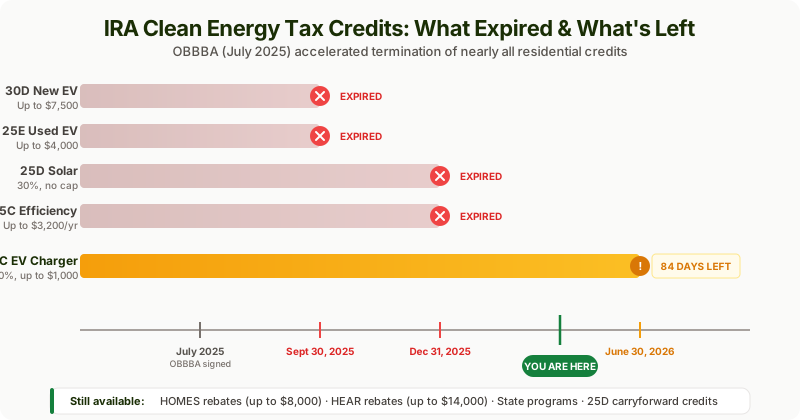
The scale of the change is striking. Credits that were designed to run through 2032 or 2033 were cut short by six to eight years. Here is the complete timeline of what expired and when, compared to what the IRA originally intended.
Credit Expiration Timeline
| Credit | IRS Section | Original IRA Expiration | OBBBA Termination Date | Max Value |
|---|---|---|---|---|
| New Clean Vehicle Credit | 30D | Dec 31, 2032 | Sept 30, 2025 | $7,500 |
| Used Clean Vehicle Credit | 25E | Dec 31, 2032 | Sept 30, 2025 | $4,000 |
| Commercial Clean Vehicle | 45W | Dec 31, 2032 | Sept 30, 2025 | $7,500/$40,000 |
| Energy Efficient Home Improvement | 25C | Dec 31, 2032 | Dec 31, 2025 | $3,200/yr |
| Residential Clean Energy | 25D | Phase-down 2033-2034 | Dec 31, 2025 | 30% (no cap) |
| EV Charger/Alt Fuel Refueling | 30C | Dec 31, 2032 | June 30, 2026 | $1,000 residential |
| New Energy Efficient Homes | 45L | Dec 31, 2032 | June 30, 2026 | $2,500-$5,000 |
| Energy Efficient Commercial Buildings | 179D | Dec 31, 2032 | June 30, 2026 (construction start) | Varies |
Let us walk through each credit in detail.
Credit-by-Credit Breakdown
New Clean Vehicle Credit (Section 30D) — Expired September 30, 2025
The headline EV credit offered up to $7,500 for qualifying new electric vehicles and fuel cell vehicles. It was originally set to expire December 31, 2032. The OBBBA terminated it for all vehicles acquired after September 30, 2025.
The credit had income limits ($300,000 for married filing jointly, $225,000 for head of household, $150,000 for single filers) and MSRP caps ($80,000 for SUVs, trucks, and vans; $55,000 for other vehicles). Battery component and critical mineral sourcing requirements also applied.
Transition rule: If you entered a written binding contract and made a payment (including a down payment or trade-in) on or before September 30, 2025, you can still claim the credit even if the vehicle was delivered later. That payment had to be more than nominal — a $100 deposit likely would not qualify, but a meaningful down payment or trade-in would. If your dealer applied the credit at the point of sale, it should already be reflected in your purchase price.
That contract window is now closed. For current EV options, our first-time EV buyers guide and best electric vehicles for every budget in 2026 can help you navigate the post-credit landscape. You can also check whether an EV still saves you money compared to gas even without the credit.
Previously Owned Clean Vehicle Credit (Section 25E) — Expired September 30, 2025
This credit offered up to $4,000 or 30 percent of the sale price (whichever was less) for qualifying used electric vehicles. The vehicle had to be at least two model years old, purchased from a licensed dealer, with a sale price of $25,000 or less. Income limits were lower than 30D: $150,000 for married filing jointly, $112,500 for head of household, $75,000 for single filers.
The same binding contract exception as 30D applies. Same expiration. This credit is gone for any vehicle acquired after September 30, 2025.
Commercial Clean Vehicle Credit (Section 45W) — Expired September 30, 2025
This credit covered commercial fleet EVs and, importantly, leased consumer vehicles. When you leased an EV, the leasing company (not you) claimed this credit and often passed the savings through as a reduced lease payment. This workaround allowed consumers who exceeded the income or MSRP limits for 30D to still benefit from a federal credit through leasing.
With 45W terminated, that lease loophole is gone too. New EV leases signed after September 30, 2025 do not carry any federal credit benefit.
Residential Clean Energy Credit (Section 25D) — Expired December 31, 2025
This was the big one for homeowners. Section 25D provided a 30 percent tax credit on the total cost — including equipment, labor, and installation — for solar panels, solar water heaters, battery storage (3+ kWh capacity), geothermal heat pumps, small wind turbines, and fuel cells installed at your primary or secondary residence. There was no dollar cap on the credit amount.
The OBBBA terminated 25D for all property where installation was completed after December 31, 2025. This is important: eligibility was based on when installation was completed and the system began producing energy, not when you paid or signed a contract. If your solar panels were not physically installed and operational by the end of 2025, you cannot claim this credit.
For homeowners who completed installations in 2025, there is a critical detail: the 25D credit is nonrefundable, meaning it cannot exceed your federal income tax liability in a given year. But unlike Section 25C, unused 25D credit amounts carry forward indefinitely. We will cover carryforward rules in detail below.
For a full breakdown of solar costs without the credit, see our guide to the real cost of installing solar panels at home.
Energy Efficient Home Improvement Credit (Section 25C) — Expired December 31, 2025
Section 25C provided a 30 percent credit for a wide range of energy efficiency upgrades: heat pumps, heat pump water heaters, central air conditioning, furnaces, boilers, insulation, windows, doors, electrical panel upgrades, and even home energy audits. The annual limits were:
- $2,000 for heat pumps and heat pump water heaters
- $1,200 for other improvements (windows capped at $600, doors at $500)
- $150 for home energy audits
- $3,200 maximum total per year
One important distinction: unlike 25D, the 25C credit applied only to equipment and materials for building envelope components like insulation, windows, and doors. Labor costs for those categories were not included. However, labor was included for heat pump installations.
The OBBBA actually rolled 25C's effective period back to apply only to property placed in service after December 31, 2022 (the IRA enhancement period), confirming that only improvements made during the IRA era qualified at the 30 percent rate.
Unlike 25D, the 25C credit could not be carried forward. It could only reduce your tax liability in the year the improvement was made. If your credit exceeded your tax bill for that year, the excess was lost.
For heat pump buyers now navigating the post-credit landscape, our guides to the best heat pumps for home in 2026, heat pumps explained, and the best heat pump water heaters in 2026 cover what is available and what it costs.
Alternative Fuel Vehicle Refueling Property Credit (Section 30C) — Expires June 30, 2026
This is the last federal tax credit standing for residential consumers, and it expires on June 30, 2026.
Section 30C offers 30 percent of the cost of installing qualified alternative fuel refueling equipment, up to $1,000 per charging port for residential installations. It covers the charger unit itself plus associated costs: the connector, wall mount or pedestal, new electrical panel if needed, conduit, wiring, and battery storage at the charging point.
There is a location requirement. Your property must be in an eligible census tract — specifically a low-income community or non-urban area. You can check whether your address qualifies using the Argonne National Laboratory 30C Tax Credit Eligibility Locator.
To claim it, file IRS Form 8911 with your tax return for the year the equipment was placed in service. The equipment must be fully installed and operational by June 30, 2026.
If you are in an eligible tract and considering a home EV charger, this is your last window for any federal help. Our guides on the best Level 2 EV chargers for home in 2026, EV charging at home, and how much it costs to install an EV charger can help you choose the right setup and understand the full cost picture. A quality Level 2 EV Charger Level 2 charger typically runs $400 to $700 for the unit, with installation adding $500 to $1,500 depending on your electrical setup.
New Energy Efficient Home Credit (Section 45L) — Expires June 30, 2026
Available to builders and developers of new energy-efficient homes. This is not a consumer-claimed credit, but it can indirectly benefit buyers if builders pass savings through as lower prices on qualifying new construction. Available through June 30, 2026.
Energy Efficient Commercial Buildings Deduction (Section 179D) — Expires June 30, 2026
Available for qualifying commercial building construction beginning on or before June 30, 2026. Not directly relevant to residential consumers, but relevant if you own commercial property.
What Can You Still Claim in 2026? Decision Table
Here is a quick reference for where you stand right now.
| Situation | Can You Claim a Federal Credit? | What to File | Deadline |
|---|---|---|---|
| Installed solar in 2025, full credit used | No further action needed | — | — |
| Installed solar in 2025, credit exceeds tax liability | Yes — carry forward unused 25D credit | Form 5695, Part I | April 15, 2026 (extension Oct 15) |
| Want to install solar in 2026 | No federal credit available | — | — |
| Bought new EV by Sept 30, 2025 | Yes — claim or verify dealer applied credit | Form 8936 | With 2025 tax return |
| Want to buy EV in 2026 | No federal credit available | — | — |
| Installed heat pump in 2025 | Yes — claim 25C credit (no carryforward) | Form 5695, Part II | April 15, 2026 (extension Oct 15) |
| Want to install heat pump in 2026 | No federal credit; check HEAR rebate | State energy office | Varies by state |
| Installing EV charger in eligible area | Yes — 30C credit, 30% up to $1,000 | Form 8911 | Equipment installed by June 30, 2026 |
| Installing EV charger outside eligible area | No federal credit available | — | — |
Carryforward Rules for Section 25D Credits
This section matters most for homeowners who installed large solar, solar-plus-battery, or geothermal systems in 2025. If your 25D credit was larger than your federal income tax liability, you did not lose the excess — you can carry it forward to 2026 and beyond until it is fully used.
How Carryforward Works
The Section 25D credit is nonrefundable: it can reduce your federal tax to zero but cannot generate a refund. If you installed a $30,000 solar system in 2025, your credit would be $9,000 (30 percent of $30,000). If your 2025 federal income tax liability was $6,000, you would use $6,000 of the credit in 2025 and carry forward $3,000 to 2026.
That $3,000 carryforward continues rolling forward each year until your tax liability absorbs it. There is no expiration on the carryforward.
How to File for Carryforward
- File Form 5695, Part I with your 2025 tax return (due April 15, 2026, or October 15, 2026 with an extension).
- Enter your total qualified expenditures and calculate the 30 percent credit.
- The form will compare your credit to your tax liability and calculate the carryforward amount.
- Transfer the credit to Schedule 3 (Form 1040), line 5b.
- In 2026 (and subsequent years), file Form 5695 again, entering the carryforward amount from the prior year.
Documentation to Keep
- Installer invoices showing total cost (equipment + labor + installation)
- Proof of installation completion date (this is what determines eligibility, not payment date)
- Manufacturer's written certification statement (keep in your records; do not attach to your return)
- Equipment specifications confirming the system qualifies (solar panels, battery capacity of 3+ kWh, etc.)
- All receipts and contracts
Common Mistakes to Avoid
Mistake 1: Confusing 25D with 25C carryforward rules. Section 25D (solar, batteries, geothermal) allows carryforward. Section 25C (heat pumps, windows, insulation) does not. If you installed a heat pump in 2025 and the credit exceeded your tax liability, the excess is lost.
Mistake 2: Not filing Form 5695 in the installation year. Even if your entire credit will be carried forward, you must file Form 5695 in the year of installation to establish the credit. You cannot skip 2025 and try to claim it for the first time in 2026.
Mistake 3: Using the wrong installation date. The IRS considers an expenditure as "made" when the original installation is completed — meaning the system is installed and operational. If your solar installer finished mounting panels on December 30, 2025 but the utility did not approve interconnection until January 5, 2026, the IRS may consider the system not yet placed in service. Get written documentation from your installer confirming the completion date.
Mistake 4: Forgetting battery storage qualifies separately. If you added a home battery as part of your solar installation, the battery cost is a separate qualifying expenditure under 25D (as long as it has 3+ kWh capacity). Make sure your installer breaks out the battery cost on the invoice so you can claim the full credit.
The Last Credit Standing: Section 30C EV Charger Guide
If there is one federal credit you can still act on right now, it is Section 30C. Here is everything you need to know.
What Qualifies
Any qualified alternative fuel vehicle refueling property installed at your primary residence. For most consumers, this means a Level 2 (240-volt) electric vehicle charger. It also covers the charger unit, connector, wall mount or pedestal, any required electrical panel upgrades, conduit, wiring, and even battery storage at the charging point.
Credit Amount
30 percent of total cost, up to $1,000 per charging port for residential installations. On a typical home charger installation costing $1,000 to $2,500 total (equipment plus installation), the credit covers $300 to $750.
Location Requirement
Your property must be in an eligible census tract: either a low-income community or a non-urban area. This is not as restrictive as it sounds — many suburban and rural areas qualify. Use the Argonne National Laboratory 30C Tax Credit Eligibility Locator to check your address before purchasing equipment.
Deadline
Equipment must be fully installed and placed in service by June 30, 2026. Given that electrical work may require permits and scheduling with an electrician, starting the process no later than May 2026 is advisable.
How to Claim
File IRS Form 8911 with your federal tax return for the year the equipment was placed in service. If you install in the first half of 2026, you will claim it on your 2026 tax return (filed in early 2027).
Recommended Chargers
A solid Level 2 EV Charger Level 2 home charger with smart features (scheduling, energy monitoring, Wi-Fi connectivity) typically costs $400 to $700. Top-rated options include models from ChargePoint, Emporia, JuiceBox, and Grizzl-E. Our best Level 2 EV chargers guide compares the top units, and our smart EV charging guide shows how to use off-peak scheduling to minimize charging costs. For a detailed walkthrough of the installation process, see our EV charger installation cost guide.
HOMES and HEAR: The Federal Programs That Survived
Here is the good news: the two largest IRA rebate programs for homeowners were not affected by the OBBBA. Congress allocated $8.8 billion combined for HOMES and HEAR, and that money is still flowing to states.
These are not tax credits — they are direct rebates, which means you do not need federal tax liability to benefit. For many lower- and moderate-income households, these programs are actually more valuable than the tax credits ever were.
HOMES (Home Energy Performance-Based Rebates)
HOMES rewards whole-home energy efficiency retrofits. Instead of incentivizing individual upgrades, it rewards the overall energy reduction achieved through a combination of improvements.
- Up to $8,000 for households earning less than 80 percent of area median income (AMI) that achieve 35 percent or greater energy savings
- Up to $4,000 for moderate-income households (80-150 percent AMI) achieving 35 percent or greater energy savings
- Lower rebate tiers available for 20 percent or greater energy savings
- Available to all income levels, though higher-income households receive smaller rebates
The process starts with a home energy audit to establish your baseline energy use and model the expected savings from proposed improvements. Our DIY home energy audit guide can help you understand where your home is losing energy before you engage with the formal audit process.
HEAR (Home Electrification and Appliance Rebates)
HEAR provides point-of-sale rebates for specific electrification upgrades. Instead of waiting until tax time, the rebate is applied when you buy the equipment, through a registered contractor.
For households at or below 80 percent AMI:
- Heat pumps (HVAC): up to $8,000
- Heat pump water heaters: up to $1,750
- Electrical panel upgrades: up to $4,000
- Insulation, wiring, ventilation: varies
- Total cap: $14,000 per household
For households between 80-150 percent AMI:
- Same categories, but rebates are capped at 50 percent of cost
- Total cap: $7,000 per household
Households above 150 percent AMI are not eligible for HEAR.
HEAR is the primary replacement for the expired Section 25C heat pump credit. For a household earning below 80 percent AMI, the $8,000 HEAR rebate for a heat pump is actually more generous than the old 25C credit (which capped at $2,000 for heat pumps). If you are considering a heat pump, check our guide to the best heat pumps for home in 2026 and our explainer on whether heat pump water heaters are worth it.
State Rollout Status
The catch is that HOMES and HEAR are administered by individual states, and rollout timelines vary enormously.
| State | Program Status (as of April 2026) |
|---|---|
| Colorado | HEAR available now for single-family homes; condos/apartments expected late 2026 |
| Washington | Active programs accepting applications |
| Hawaii | HOMES and HEAR pathways available |
| Oregon | Launching spring 2026 |
| New Hampshire | Expected mid-summer 2026 |
| Texas | Launch anticipated in 2026 |
| California | Single-family HEAR program fully reserved (waitlist) |
| Minnesota | Waiting for DOE approval |
| Florida | Declined federal allocation — not available |
| South Dakota | Declined federal allocation — not available |
Check with your state energy office for the latest status. The Department of Energy maintains a tracker of state program launches.
Can You Combine HOMES and HEAR With Other Incentives?
Yes, generally. HOMES rebates, HEAR rebates, state incentives, and utility rebates can typically be combined on the same project as long as you are not double-counting the same cost. For example, you could use a HEAR rebate for a heat pump and a state utility rebate for installation, as long as the total rebate amount does not exceed the total project cost.
Our guide on how to stack energy rebates and incentives walks through the strategy for maximizing combined savings across programs.
Category-by-Category: What to Do in 2026
Solar Panels
Federal credit status: Expired December 31, 2025 (Section 25D). No direct federal credit for homeowner-owned systems in 2026.
What to do instead:
Solar leases and PPAs remain the most accessible path to affordable solar without upfront credits. The commercial-side Section 48E Clean Electricity Investment Credit still applies to solar and wind projects that begin construction before July 4, 2026. When you sign a solar lease or Power Purchase Agreement, the solar company owns the panels and claims the 48E credit, passing those savings to you through lower monthly payments or a reduced per-kilowatt-hour rate. But the clock is ticking — solar projects beginning construction after July 4, 2026 face a placed-in-service deadline of December 31, 2027, after which the credit for solar effectively ends. If you are considering a lease or PPA, starting in early-to-mid 2026 gives you the best shot at favorable pricing. Our solar financing guide compares cash purchase, lease, and loan options.
State incentives vary widely. The best states for solar in 2026:
- New York: 25 percent state tax credit (up to $5,000) plus NY-Sun rebates, sales and property tax exemptions, and strong net metering
- New Jersey: Full 1:1 net metering, ADI program ($85.90/MWh for 15 years), no sales tax on solar
- South Carolina: 25 percent state credit (up to $35,000 over 10 years)
- Massachusetts: Full 1:1 net metering, SMART program incentive payments over 20 years, high utility rates (25-30 cents/kWh) that improve ROI
- Connecticut, Vermont, Maine, Maryland: Strong net metering and state incentives
Even without federal credits, solar equipment costs continue to decline, and the savings on electricity bills make solar financially attractive in most states. For the full financial picture, read our guides to choosing the best solar panels, the best solar inverters, and the real cost of solar installation.
Battery Storage
Federal credit status: Expired December 31, 2025 (previously covered under 25D).
What to do instead: State programs are your best bet. California's Self-Generation Incentive Program (SGIP) provides per-kilowatt rebates with higher incentives for customers in fire-threat districts. Colorado's Renewable Battery Connect offers $350 per kilowatt (up to $5,000) plus an annual participation payment. Oregon provides up to $2,500. The Massachusetts SMART program pays a higher per-kilowatt-hour rate if your solar installation includes battery storage.
Battery storage is becoming more important as net metering policies weaken in some states. If your utility is shifting to time-of-use rates or reducing net metering credits, a battery lets you store surplus solar energy and use it during expensive peak hours instead of exporting it at a low rate. You may also be able to earn money through a virtual power plant program that pays you to share stored energy during grid peaks.
Our home battery storage guide covers the top systems, our guide on whether you actually need a home battery helps you decide, and our how to buy a home battery guide walks through the purchasing process. For backup power comparisons, see generator vs. battery backup and Tesla Powerwall vs. Enphase IQ Battery.
Heat Pumps and HVAC
Federal credit status: Expired December 31, 2025 (Section 25C covered heat pumps up to $2,000, other HVAC up to $600).
What to do instead: HEAR is the primary replacement. For income-qualified households, the HEAR rebate of up to $8,000 for a heat pump is actually four times more generous than the old 25C credit. Many utility companies also offer their own heat pump rebates that can be stacked with HEAR.
Massachusetts has some of the most generous state incentives: up to $15,000 for ground-source heat pumps ($25,000 for income-qualified) and up to $16,000 for air-to-water systems. Our geothermal heat pumps guide covers ground-source options in detail.
For heat pump water heaters specifically, the HEAR rebate covers up to $1,750, and many utilities add their own rebates on top. See our best heat pump water heaters in 2026 guide.
Electric Vehicles
Federal credit status: All EV credits expired September 30, 2025 (30D, 25E, 45W).
What to do instead: There is no federal replacement. Some states offer their own EV incentives:
- Colorado: Up to $5,000 for new EVs
- Oregon: Up to $7,500 for income-qualified buyers
- New York: Drive Clean rebate of up to $2,000
- Several other states offer smaller rebates
The OBBBA did introduce a new tax deduction for auto loan interest (up to $10,000 for vehicles assembled in the US with an MSRP under $100,000), which partially offsets the lost EV credit for financed purchases. However, this benefit applies to all vehicles, not just electric ones.
Even without credits, the total cost of ownership for an EV is often lower than a comparable gas vehicle when you factor in fuel savings, lower maintenance, and no oil changes. Our EV cost of ownership guide runs the numbers, and our best electric vehicles for every budget in 2026 covers affordable options.
EV Chargers
Federal credit status: Section 30C available through June 30, 2026 (30 percent, up to $1,000 residential). Must be in an eligible census tract.
What to do: If you qualify, install before the June 30, 2026 deadline. Even if the credit is modest, combining it with a state or utility rebate can meaningfully reduce costs. Check our guides on EV charging at home, installation costs, and smart EV charging for savings.
Geothermal
Federal credit status: Residential credit expired December 31, 2025 (25D). Commercial credit (48E) still available for non-solar/wind technologies with an extended phase-out: 100 percent through 2033, phasing to zero by 2036.
What to do instead: Like solar, geothermal can be structured through third-party ownership arrangements that utilize the commercial credit. The longer runway for non-solar 48E credits (through 2033 versus July 2026 for solar) means geothermal leasing arrangements have more time to develop. Check state incentives as well — geothermal qualifies for many state renewable energy programs. Our geothermal heat pumps guide covers the technology, costs, and savings in detail.
Windows, Doors, and Insulation
Federal credit status: Expired December 31, 2025 (Section 25C).
What to do instead: HOMES whole-house rebates may cover these improvements as part of a comprehensive energy retrofit. HEAR rebates cover insulation specifically. Many utility companies offer rebates for weatherization improvements. Our attic insulation guide, best home insulation types compared, DIY air sealing guide, and home insulation and weatherization guide provide detailed instructions for reducing energy waste.
How to Claim Credits on Your 2025 Tax Return
If you made qualifying clean energy improvements in 2025 or earlier, here is exactly how to claim them. Your 2025 tax return is due April 15, 2026 (with an automatic extension to October 15, 2026 if you file Form 4868).
Form 5695: Residential Energy Credits (Sections 25D and 25C)
Part I — Residential Clean Energy Credit (Section 25D):
- Enter your qualified expenditures for solar, battery, geothermal, wind, or fuel cell systems.
- Calculate 30 percent of the total qualifying costs.
- Compare the resulting credit to your federal income tax liability (from Form 1040).
- If the credit exceeds your tax liability, record the excess as a carryforward amount.
- Transfer the allowable credit to Schedule 3 (Form 1040), line 5b.
Part II — Energy Efficient Home Improvement Credit (Section 25C):
- Enter costs for each category of qualifying improvement (heat pumps, windows, insulation, etc.).
- Apply the applicable sub-limits ($2,000 for heat pumps, $600 for windows, $500 for doors, $150 for energy audits).
- Calculate 30 percent of qualifying costs, subject to the $3,200 annual cap.
- Remember: 25C cannot be carried forward. Use it or lose it in the year of installation.
Form 8911: Alternative Fuel Vehicle Refueling Property Credit (Section 30C)
- Enter the cost of qualifying refueling property (charger, installation, electrical work).
- Calculate 30 percent of the total cost (maximum $1,000 per charging port for residential).
- File with your income tax return for the year the equipment was placed in service.
Form 8936: Clean Vehicle Credits (Sections 30D and 25E)
- For vehicles acquired on or before September 30, 2025 (or under a binding contract with payment by that date).
- Enter vehicle information and calculate the credit amount.
- If you transferred the credit to the dealer at the point of sale, the credit should already be reflected in your purchase price — verify this matches your records.
Documentation Checklist
Keep all of the following in your records for at least three years after filing:
- Installer invoices with itemized costs (equipment, labor, installation)
- Proof of installation completion date (signed completion certificate from installer)
- Manufacturer's written certification statement for each qualifying product
- Equipment specifications (panel wattage, battery capacity, efficiency ratings)
- All receipts and purchase contracts
- For EV chargers: confirmation that your address is in an eligible census tract
- For EVs: binding contract and proof of payment by September 30, 2025
Tax software like TurboTax or H&R Block can walk you through these forms step by step, or work with a qualified tax professional if your situation involves multiple credits or carryforward amounts.
The Supply Chain Wild Card: FEOC Restrictions
The OBBBA introduced Foreign Entity of Concern (FEOC) restrictions that affect the commercial clean energy credits still available. For projects beginning construction after December 31, 2025, the solar company or developer must certify that no components come from prohibited foreign entities, including companies tied to China, Russia, North Korea, and Iran.
Since China has been the dominant global manufacturer of solar panels, battery cells, and many clean energy components, these restrictions are reshaping supply chains in real time. The practical effect for consumers is uncertain but could mean higher prices for leased solar systems and battery storage as manufacturers and developers adjust their sourcing.
The IRS is expected to release safe harbor tables by December 31, 2026 that will clarify exactly which components trigger FEOC disqualification. Until then, solar companies and developers are navigating some ambiguity, which may affect contract terms and pricing for solar leases and PPAs.
State Incentives: Your Most Important Resource in 2026
With most federal credits gone, state and local incentives are now the primary financial driver for residential clean energy adoption. The variation between states is enormous.
A homeowner in New York can stack a 25 percent state tax credit, NY-Sun rebates, property tax exemptions, and full retail net metering for a total incentive package worth thousands. A homeowner in a state with no solar incentives and weak net metering faces a much longer payback period.
States With Solar Renewable Energy Certificates (SRECs)
In SREC states, your solar panels earn certificates for every megawatt-hour they produce, and you can sell those certificates for additional income. SREC states include New Jersey, Massachusetts, Pennsylvania, Maryland, Ohio, Washington D.C., Delaware, and Illinois. These payments can add hundreds or even thousands of dollars per year to your solar savings.
Community Solar
If you cannot install rooftop solar — because you rent, have a shaded roof, or live in a condo — community solar programs let you subscribe to a share of a local solar farm and receive credits on your electricity bill. Available in 22+ states, community solar requires no installation and typically saves subscribers 5 to 15 percent on their electric bill.
Finding Your State and Local Incentives
The best resource is the Database of State Incentives for Renewables and Efficiency (DSIRE) at dsireusa.org. Enter your zip code and it will show you every federal, state, local, and utility incentive you qualify for.
Our guide to state clean energy incentives beyond federal covers the best programs by state, and for net metering specifically — which remains one of the most valuable solar benefits in 34 states — our guide on how net metering works and how to maximize it explains the details. To understand your current energy costs and savings potential, check our state electricity rate guides for California, Texas, New York, Florida, and Illinois.
Frequently Asked Questions
Can I still get the federal solar tax credit in 2026? No. The Section 25D Residential Clean Energy Credit expired December 31, 2025. However, if you completed a solar installation in 2025 and did not use the full credit due to tax liability limits, you can carry the unused portion forward to 2026 and beyond. File Form 5695 with your 2025 tax return.
What is the last day to claim the EV charger credit? Equipment must be installed and placed in service by June 30, 2026. File Form 8911 with your tax return for the year of installation. Your property must be in an eligible census tract.
I installed solar in 2025 but my credit is bigger than my tax bill. What do I do? You carry forward the unused credit. File Form 5695 with your 2025 return to establish the credit and calculate the carryforward amount. The excess rolls to 2026, 2027, and beyond until fully used. There is no expiration on the carryforward.
Are HOMES and HEAR rebates still available? Yes. These IRA-funded rebate programs are separate from tax credits and were not affected by the OBBBA. They are administered by individual states and are rolling out throughout 2026. Check your state energy office for availability.
What happened to the $7,500 EV tax credit? The Section 30D New Clean Vehicle Credit was terminated for vehicles acquired after September 30, 2025. If you had a binding contract with payment by that date, you can still claim it on your 2025 return even if the vehicle was delivered later. For the full post-OBBBA picture, including remaining state-level programs, see our 2026 EV tax credits and incentives guide.
Can I combine state incentives with federal rebates like HOMES and HEAR? Yes, generally. You can stack HOMES rebates, HEAR rebates, state incentives, and utility rebates on the same project as long as you are not using two programs to cover the exact same cost. See our guide to stacking rebates and incentives for strategies.
Is solar still worth it without the federal tax credit? For most homeowners, yes. Solar equipment costs have dropped significantly, electricity rates continue to rise in most states, and state incentives can offset a substantial portion of the cost. The payback period is longer without the 30 percent federal credit, but solar still generates positive returns over its 25-30 year lifespan in most markets. Run the numbers using our real cost of solar guide.
What form do I file for the EV charger credit? IRS Form 8911, Alternative Fuel Vehicle Refueling Property Credit. File it with your federal tax return for the year the charger was installed and placed in service.
How do I check if my area qualifies for the 30C EV charger credit? Use the Argonne National Laboratory 30C Tax Credit Eligibility Locator. Enter your address to see if your census tract qualifies as a low-income community or non-urban area.
What is the OBBBA and why did it change energy credits? The One Big Beautiful Bill Act (Public Law 119-21) was signed July 4, 2025. It is a broad fiscal policy bill that, among many provisions, accelerated the expiration of most IRA clean energy tax credits. Credits originally designed to run through 2032 or 2033 were terminated years early.
Action Plan: What to Do Based on Your Situation
If You Installed Solar, Battery, or Geothermal in 2025
- File Form 5695 with your 2025 tax return by April 15, 2026.
- Calculate whether the credit exceeds your tax liability.
- If it does, carry forward the excess — it does not expire.
- Keep all documentation (invoices, completion certificates, manufacturer certifications) for at least three years.
- Consider whether adding a battery to an existing solar system makes sense using state incentives.
If You Are Considering Solar in 2026
- Get quotes from multiple installers — costs have dropped even without the credit.
- Explore solar leases and PPAs to benefit indirectly from the commercial 48E credit (start before mid-2026 for the best terms).
- Check your state incentives at DSIRE (dsireusa.org).
- Understand your net metering policy — it is now the single biggest factor in solar economics.
- Look into community solar if rooftop installation is not feasible.
If You Want an EV Charger
- Check if your address qualifies for the 30C credit using the Argonne Lab locator.
- If yes, purchase and install a Level 2 charger before June 30, 2026.
- File Form 8911 with your 2026 tax return.
- Check for additional state or utility charger rebates to stack with the federal credit.
- Browse our best Level 2 EV chargers guide for recommendations.
If You Need a Heat Pump or Energy Efficiency Upgrades
- Check if HOMES or HEAR is active in your state.
- If HEAR is available, find a registered contractor through your state energy office.
- For HOMES, start with a home energy audit to establish your baseline.
- Look for utility company rebates that can be stacked with federal rebates.
- Consider a whole-home electrification approach to maximize savings and rebate value.
If You Are Buying an EV
- Accept that the federal credit is gone — focus on state incentives and total cost of ownership.
- Check your state for any remaining EV rebates (Colorado, Oregon, New York, and others still offer them).
- Factor in fuel savings: charging an EV costs roughly 60-70 percent less per mile than gasoline.
- Use our EV cost of ownership calculator to compare total costs.
- If you are financing, the new auto loan interest deduction (up to $10,000 for US-assembled vehicles under $100,000 MSRP) applies to all vehicles.
What Comes Next
The clean energy incentive landscape is not static. Several factors could reshape it in the coming months and years.
The commercial credits for solar and wind (48E/45Y) face a hard construction-start deadline of July 4, 2026, after which projects must be placed in service by December 31, 2027. This means the solar lease and PPA market may tighten significantly by late 2026 and into 2027.
Non-solar clean energy technologies like geothermal, battery storage, and hydropower retain their commercial credits through 2033 under the original IRA phase-out schedule. Third-party ownership options for those technologies have a longer runway, which could create interesting financing arrangements for geothermal and battery installations.
The HOMES and HEAR rebate programs will continue rolling out across states through 2026 and beyond. These represent the most significant remaining federal support for consumer clean energy adoption, and more states are expected to launch programs in the coming months.
State legislatures continue to act. Several states are considering new or expanded clean energy incentive programs specifically to fill the gap left by the federal credit expirations. If you live in a state that has historically relied heavily on federal credits, watch for new legislation.
The Bottom Line
The Inflation Reduction Act's consumer clean energy tax credits were historic in scope, and their early termination under the One Big Beautiful Bill represents a genuine loss for homeowners interested in solar, EVs, heat pumps, and energy efficiency upgrades. The federal government is no longer subsidizing these purchases the way it was from 2022 through 2025.
But that does not mean clean energy is unaffordable. State incentive programs, the surviving HOMES and HEAR rebate programs, commercial credits that flow through to consumers via leases and PPAs, declining equipment costs, and the simple economics of generating your own electricity or driving on cheaper fuel all continue to make clean energy a smart financial decision for many households.
The key is to understand what is available to you specifically, based on where you live, what improvements you are considering, and your household income level. Use DSIRE to find your local incentives, check whether HOMES and HEAR are active in your state, get multiple quotes from installers, and consider third-party ownership options that leverage the commercial credits still in play.
The window is not fully closed. But it is narrower than it was, and for some credits — especially the Section 30C EV charger credit expiring June 30, 2026 — it is closing fast. If you have been considering a clean energy upgrade, doing your research now and acting in the first half of 2026 puts you in the best position to capture whatever value remains.
For deeper dives into specific topics, explore our guides on solar incentives and tax credits in 2026, the real cost of solar panels, home battery storage, whether you need a home battery, EV charging at home, EV charger installation costs, how net metering works, stacking rebates and incentives, and state clean energy incentives.
Solar Tool
Run the solar payback calculator before you compare quotes
Estimate system size, net cost, first-year savings, and simple payback using your own bill and assumptions instead of relying only on installer projections.
EV Charging Tool
Estimate what charging at home should really cost
Use your mileage, electricity rate, and charging schedule to estimate monthly EV charging cost and compare it with a gas vehicle.
Keep learning
Get the next practical clean energy guide in your inbox
We send focused, consumer-friendly advice on costs, comparisons, and what to do next.
No spam. Unsubscribe anytime.
Reviewed By Watt Wise
Consumer-first clean energy guidance
Watt Wise publishes practical explainers for homeowners, renters, and EV drivers making real decisions about solar, costs, incentives, and energy savings.
Focus
Costs, tradeoffs, and what to do next.
Approach
Plain language over sales copy or jargon.
Standards
Updated as pricing, incentives, and rules change.
Editorial Methodology
How this solar guide is maintained
Watt Wise guides are built to help readers understand real-world costs, tradeoffs, and next steps before they spend money. We update time-sensitive pages when incentives, utility rules, pricing, or product availability materially change.
What we look at
Costs, compatibility, warranties, utility rules, incentives, and where common buyer mistakes happen.
Update status
Last material update: April 6, 2026.
Next Reads
Keep the research moving
Related guide
State Clean Energy Incentives Beyond Federal
Federal solar tax credits expired, but state clean energy incentives still offer thousands in savings. Find SRECs, state tax credits, and rebates in your state.
Related guide
Solar Incentives and Tax Credits in 2026
The federal solar tax credit expired in 2025, but state incentives, leasing options, and net metering still make solar worthwhile in 2026. Here's what to know.
Related guide
EV Tax Credits and Incentives in 2026
Federal EV tax credits expired in 2025, but the 30C charger credit and state rebates remain. Learn what's left and how to claim every dollar.