How to Cut Your Electric Bill in Half
Who This Is For
Homeowners comparing quotes, running payback math, or deciding whether solar belongs in a larger home energy plan.
You’ll Leave With
- Where Your Electricity Actually Goes
- Tier 1: Free Strategies (Save $460–$840 per Year)
- Strategy 1: Time-of-Use Rate Optimization — Save $100–$300/Year
- Strategy 2: Thermostat Adjustments — Save $100–$180/Year
Best Next Step
Keep moving instead of starting over
When you finish this article, use the next guide below to compare options or validate your plan.
See what to ask installers→How to Cut Your Electric Bill in Half
The average American household now pays about $163 per month for electricity — roughly $1,960 per year. That is a 26 percent increase from just five years ago, driven by rising fuel costs, grid modernization charges, and surging demand from data centers and electric vehicles. If your bill feels like it has been creeping up every single quarter, you are not imagining it.
Here is what most people get wrong: they assume cutting their bill in half requires solar panels or a five-figure investment. It does not. Free and low-cost strategies alone — things like adjusting your thermostat, shifting when you run appliances, and swapping light bulbs — can save a typical household roughly $1,400 per year. Against a $1,960 average bill, that already exceeds the 50 percent target.
This guide covers 12 proven strategies organized into four investment tiers: free changes, low-cost upgrades, moderate investments, and major upgrades. Start at the top and work your way down as your budget allows. Every layer of savings compounds on the ones before it.
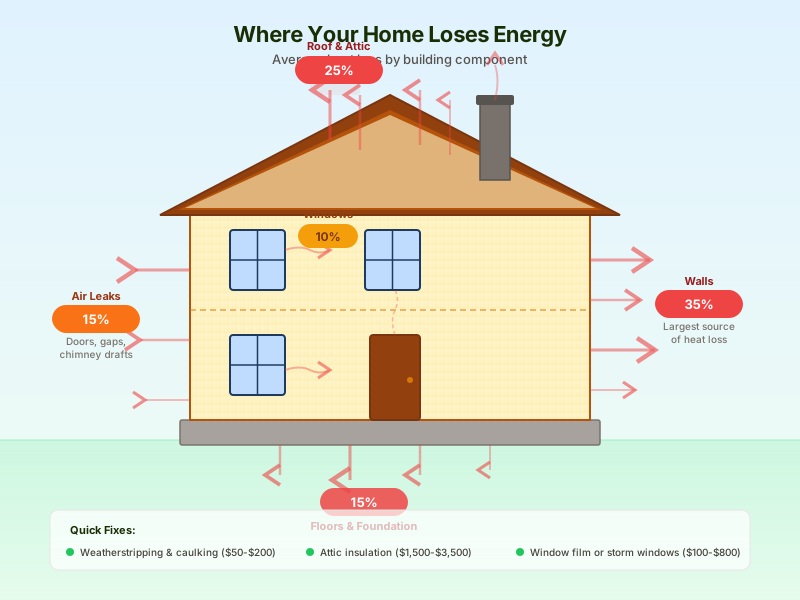
Where Your Electricity Actually Goes
Before you can cut your bill, you need to understand what is driving it. Here is how the average US home uses electricity:
| Category | Share of Bill | Annual Cost (~$1,960) |
|---|---|---|
| Heating and cooling (HVAC) | 46% | ~$900 |
| Water heating | 14–18% | ~$315 |
| Lighting | 9–15% | ~$235 |
| Washer and dryer | 6% | ~$118 |
| Kitchen appliances | 5% | ~$98 |
| Refrigerator and freezer | 4% | ~$78 |
| TVs and electronics | 4% | ~$78 |
| Vampire loads (always-on devices) | 5–10% | ~$147 |
Nearly half your bill comes from heating and cooling alone. That is why the most impactful strategies in this guide target HVAC efficiency. But do not ignore the smaller categories — cutting 50 percent from several small slices adds up fast.
Tier 1: Free Strategies (Save $460–$840 per Year)
These strategies cost nothing and take minutes to implement. They are behavioral changes and simple adjustments that start saving money immediately.
Strategy 1: Time-of-Use Rate Optimization — Save $100–$300/Year
If your utility offers time-of-use (TOU) rates — and an increasing number do — you are paying a premium for electricity during peak hours and much less during off-peak hours. The difference can be dramatic: PG&E charges $0.56/kWh at peak versus $0.18/kWh at super off-peak, a 3x spread. Southern California Edison peaks at $0.71/kWh versus $0.36/kWh off-peak.
Peak hours are typically 3–7 PM or 4–9 PM on weekdays. Off-peak is usually 9 PM to 6 AM.
What to shift to off-peak:
- Dishwasher (use the delay-start timer)
- Washing machine and dryer
- Electric water heater (put it on a timer)
- Pool pump
- EV charging
- Battery charging (for peak-hour discharge)
The strategy costs nothing — you're just changing when you use electricity, not how much. Most households save $100–$300 per year. Contact your utility to switch to a TOU plan, which may require a smart meter installation (also free from most utilities).
For a deep dive on TOU strategies, read our complete guide to time-of-use electricity rates.
Strategy 2: Thermostat Adjustments — Save $100–$180/Year
This is the single most impactful free change you can make. Every degree Fahrenheit you lower your heating setpoint saves roughly 3 percent on your heating bill. Every degree you raise your cooling setpoint in summer saves a similar amount.
The Department of Energy recommends:
- Winter: 68°F when you're home and awake, 60°F when sleeping or away
- Summer: 78°F when you're home, higher when you're out
If your household currently keeps the thermostat at 72°F year-round, these adjustments alone could save $100–$180 per year. Use ceiling fans to circulate air in summer — a ceiling fan costs about 1 cent per hour compared to 36 cents per hour for central AC, and lets you raise the thermostat by 4 degrees without sacrificing comfort.
Strategy 3: Eliminate Vampire Loads — Save $50–$200/Year
Vampire loads — the electricity consumed by devices that are plugged in but not actively in use — account for 5–10 percent of total household electricity consumption. That is $100–$200 per year being silently drained by cable boxes, game consoles, phone chargers, and smart home devices sitting in standby mode.
The worst offenders:
| Device | Standby Power |
|---|---|
| Cable box / DVR | 10–30 watts |
| Gaming console | 5–15 watts |
| Router / modem | 5–15 watts |
| Smart speakers and displays | 2–5 watts each |
| Phone / laptop chargers (plugged in, no device) | 1–5 watts each |
The DOE recommends a simple test: check your smart meter reading at 3 AM. If your consumption is not significantly lower than at 7 PM, you have a vampire load problem.
Fixes (all free):
- Unplug devices you do not use daily
- Plug groups of electronics into power strips and switch the strip off when not in use
- A smart power strip with auto-shutoff ($25–$40) can do this automatically and typically saves $50–$150 per year
For specific product recommendations, check out our smart home energy management guide.
Strategy 4: Laundry and Ventilation Habits — Save $160/Year
Cold water laundry: About 90 percent of the energy your washing machine uses goes to heating the water. Switching to cold water for most loads saves roughly $60 per year with zero impact on cleaning performance for everyday clothes.
Air drying: Skipping the dryer even part of the time saves another $50–$100 per year. Your dryer is one of the most energy-intensive appliances in your home, pulling 1,800–5,000 watts per load.
Natural light and ventilation: Open curtains during winter days to let sunlight warm your home passively. Close them at night to insulate. In summer, open windows during cool mornings and evenings instead of running the AC.
Tier 1 Summary
| Strategy | Annual Savings |
|---|---|
| TOU rate optimization | $100–$300 |
| Thermostat adjustments | $100–$180 |
| Vampire load elimination | $50–$200 |
| Cold water wash + air drying | $160 |
| Tier 1 Total | $460–$840 |
That is up to 43 percent of the average bill — and you have not spent a dime.
Tier 2: Low-Cost Upgrades — $25–$600 (Save $450–$1,050 More per Year)
These investments pay for themselves within weeks to months.
Strategy 5: LED Lighting — Save $150–$300/Year
If you still have incandescent or CFL bulbs anywhere in your home, replacing them with LEDs is one of the highest-return upgrades you can make. LEDs use up to 90 percent less energy than incandescent bulbs and last 25 times longer, according to the Department of Energy.
The average household saves $225 per year by switching to all-LED lighting. Individual bulbs save $15–$20 per year each, and a typical home has about 50 light sockets. At $1–$5 per bulb, the entire house can be converted for $50–$150 with a payback period measured in weeks.
LEDs also produce dramatically less heat. Incandescent bulbs release 90 percent of their energy as heat, which means in summer your old bulbs are not just wasting electricity directly — they are also making your air conditioner work harder.
Start with your most-used fixtures: kitchen, living room, porch lights, and any lights that run more than three hours per day. Look for ENERGY STAR certified bulbs for best efficiency.
Strategy 6: Smart Thermostat — Save $50–$200/Year
Since heating and cooling account for almost half your bill, making your HVAC system smarter is one of the best investments you can make. An ENERGY STAR certified smart thermostat saves approximately 8 percent on heating and cooling costs.
But the real savings come from advanced features. Smart thermostats learn your schedule and adjust automatically. They use geofencing to detect when you leave and return. They can implement pre-cooling strategies that take advantage of TOU rates — which pushes savings to $240–$720 per year when combined with a TOU plan.
Top picks for 2026:
- Nest Learning Thermostat — Nest Learning Thermostat (4th gen, ~$250): 10–12% heating savings, 15% cooling savings
- Ecobee Smart Thermostat Premium — Ecobee Smart Thermostat Premium (~$250): up to 23% savings, room sensors included
- Honeywell T9 (~$170): strong multi-room sensing
- Amazon Smart Thermostat (~$60): budget pick with Alexa integration
At $60–$250 for the device, a smart thermostat pays for itself in 6–18 months and keeps saving money for a decade. Many utilities offer $50–$100 rebates on top. For a full comparison, see our best smart thermostats for energy savings and our smart thermostat installation DIY guide.
Strategy 7: Weatherstripping and Air Sealing — Save $200–$400/Year
Air leaks around windows, doors, and ductwork are responsible for significant energy waste, and sealing them is one of the cheapest improvements you can make. A $20–$50 investment in weatherstripping and caulk can reduce your heating and cooling costs by 10–20 percent, saving $200–$400 per year according to DOE estimates.
Common leak points:
- Gaps around door frames and window frames
- Electrical outlets on exterior walls
- Plumbing penetrations
- Attic hatches and pull-down stairs
- Recessed light housings
- Dryer vents and exhaust fan openings
You can find most leaks by holding your hand near these areas on a cold or windy day and feeling for drafts. Our DIY air sealing guide walks through the full process step by step.
Whole-Home Energy Monitor — Save $100–$200/Year
You cannot manage what you cannot measure. A whole-home energy monitor like the Emporia Vue energy monitor — Emporia Vue Energy Monitor ($150–$300) clamps onto your electrical panel and shows you exactly where every watt is going in real time.
Most homeowners who install one discover at least one surprise: a basement dehumidifier running 24/7, a second refrigerator in the garage costing $150 per year, or an old pool pump consuming more than the air conditioner. These monitors typically help identify $100–$200 in annual savings you would never spot otherwise.
For product comparisons, see our best home energy monitors for 2026.
Tier 2 Summary
| Strategy | Cost | Annual Savings |
|---|---|---|
| LED lighting (whole home) | $50–$150 | $150–$300 |
| Smart thermostat | $60–$250 | $50–$200 |
| Weatherstripping + caulking | $20–$50 | $200–$400 |
| Smart power strips (3–5) | $75–$150 | $50–$150 |
| Energy monitor | $150–$300 | $100–$200 |
| Tier 2 Total | $355–$900 | $450–$1,050 |
The Key Insight: Tiers 1 + 2 Can Get You to 50%
Combined, Tiers 1 and 2 deliver $910–$1,890 per year in savings against a $1,960 average bill. Even accounting for overlap between strategies (real-world totals run 60–80 percent of the raw sum), a conservative estimate of ~$1,400 per year still exceeds the 50 percent target.
You do not need solar panels. You do not need a heat pump. You do not need to spend thousands of dollars. Free behavioral changes and a few hundred dollars in low-cost upgrades can cut your electric bill in half.
Everything below this line takes your savings further — but the point above bears repeating: the 50 percent goal is achievable on a budget.
Tier 3: Moderate Investments — $1,500–$8,500 (Save $600–$1,500 More per Year)
These upgrades require a more significant upfront investment but deliver substantial ongoing savings and often qualify for rebates.
Strategy 8: Home Energy Audit — $437 Average Cost, $685/Year Savings
An energy audit is the single best starting point for targeted investments. It tells you exactly where your money is going and which fixes deliver the biggest payback. Think of it as a financial checkup for your house.
Audit levels and costs:
| Level | What It Includes | Cost |
|---|---|---|
| Level 1 | Walkthrough + bill review | $100–$250 |
| Level 2 | In-depth survey + analysis | $250–$650 |
| Level 3 | Comprehensive with blower door test | $650–$1,000+ |
The average audit costs $437 and identifies $685 per year in savings — a payback period of roughly 7 months. Many utilities offer free or heavily subsidized audits. The Weatherization Assistance Program (WAP) provides no-cost audits for low-income households (at or below 200 percent of the federal poverty level), with average improvement value of $6,500–$8,000 per home.
You can also do a basic DIY audit for free — check for drafts, inspect insulation levels, and review utility bills for seasonal patterns. Our DIY home energy audit guide walks you through it.
Strategy 9: Insulation and Weatherization — Save $360–$720/Year
If your home was built before 2000, there is a good chance your insulation is below current standards. The Department of Energy reports that proper weatherization can reduce energy costs by up to 30 percent. For a home spending $200 per month on energy, that is $360–$720 per year in savings.
Specific upgrades and costs:
| Upgrade | Cost | Annual Savings | Payback |
|---|---|---|---|
| Attic insulation | $1,500–$3,000 | $200–$500 | 3–5 years |
| Wall insulation (blown-in) | $2,000–$5,000 | $100–$300 | 7–10 years |
| Air sealing (professional) | $200–$800 | $200–$400 | <1 year |
| Window film / plastic sheeting | $10–$30/window | $20–$50 | Weeks |
Attic insulation is the biggest bang for the buck. Adding insulation to floors over crawl spaces and accessible basement rim joists increases savings further. A comprehensive weatherization effort — insulation, professional air sealing, and duct sealing — can save $500–$1,000 per year with a payback period of two to five years.
For a complete breakdown, see our home insulation and weatherization guide and our attic insulation guide.
Strategy 10: Appliance Upgrades — Save $100–$450/Year
ENERGY STAR certified appliances use 10–50 percent less electricity than standard models. Across a full set of appliances, the savings add up to approximately $450 per year (a 24 percent reduction) and $8,750 over product lifetimes. Not sure which items deserve priority? Our guide to how much electricity each appliance uses ranks every major load in a typical home.
Savings by appliance:
| Appliance | Annual Savings vs Old Model |
|---|---|
| Refrigerator (ENERGY STAR Most Efficient) | $85–$200 |
| Washing machine (front-loader, Most Efficient) | $50–$70 |
| Dishwasher (ENERGY STAR) | ~$40 |
| Heat pump dryer | 20–60% more efficient than conventional |
A refrigerator from 2010 might consume 500–800 kWh per year while a new ENERGY STAR model uses 300–400 kWh. If you are running a second refrigerator in your garage — especially an older one — unplugging it or replacing it could save $100–$200 per year on its own.
Do not rush out and replace working appliances. But when something reaches end of life, prioritize the ENERGY STAR label. Heat pump dryers are particularly worth the premium at replacement time — they are 20–60 percent more efficient than conventional models.
Heat pump water heaters deserve special mention. Your water heater accounts for 14–18 percent of your electric bill. Switching from a standard electric resistance heater to a heat pump water heater cuts that consumption by 50–75 percent, saving roughly $550 per year for a family of four. At $1,500–$3,500 installed, payback is about 3 years, with lifetime savings exceeding $5,600. The IRA electrification rebate covers 50–100 percent of costs up to $1,750 for qualifying households.
For a full comparison, see our best heat pump water heaters for 2026 and heat pump water heaters: are they worth it?.
Tier 3 Summary
| Strategy | Cost | Annual Savings |
|---|---|---|
| Energy audit | $100–$1,000 | $685 (from recommendations) |
| Attic insulation | $1,500–$3,000 | $200–$500 |
| ENERGY STAR appliances | $500–$2,000 | $100–$450 |
| Heat pump water heater | $1,500–$3,500 | $300–$550 |
| Tier 3 Total | $3,600–$9,500 | $600–$1,500 |
Tier 4: Major Upgrades — $4,000+ (Save $1,870–$4,020 More per Year)
These are the big moves that can transform your electricity costs permanently. They require significant upfront investment but deliver the largest long-term savings.
Strategy 11: Heat Pump HVAC — Save $370–$1,000/Year
Since heating and cooling represent 46 percent of your electric bill, upgrading to a heat pump HVAC system is one of the single most impactful changes you can make. Heat pumps both heat and cool, replacing your furnace and AC with one system that is 2–4 times more efficient.
A heat pump delivers 3–4 units of heat for every unit of electricity consumed (a coefficient of performance of 3–4x). The DOE reports average savings of $370 per year, but households replacing electric resistance heating (baseboard heaters, electric furnaces) or fuel oil/propane systems see savings closer to $1,000 per year. Over 10 years, that is approximately $8,500 saved compared to a gas furnace plus AC.
System options:
| Type | Cost (Installed) | Best For |
|---|---|---|
| Central ducted heat pump | $4,000–$12,000 | Homes with existing ductwork |
| Ductless mini-splits | $3,000–$8,000 | Specific zones, additions, older homes |
| Geothermal heat pump | $15,000–$35,000 | Maximum efficiency (COP 4–5), long-term |
Modern cold-climate heat pumps work efficiently in temperatures well below zero — do not assume they are only for mild climates. For a detailed comparison, read our heat pumps explained guide, our best heat pumps for home 2026, and our geothermal heat pumps guide.
Strategy 12: Solar Panels — Save $1,200–$1,820/Year
Solar is the most impactful single investment for cutting your bill. In many markets it can eliminate 75–90 percent of your electricity cost.
Key numbers for 2026:
| Metric | Value |
|---|---|
| Average household savings | ~$1,820/year |
| Average system cost | $15,000–$33,000 (national avg ~$19,873) |
| Cost per watt | $2.50–$3.50 installed |
| 25-year savings | $37,000–$154,000 |
| Payback period | 5–15 years (varies by state) |
Critical 2026 update: The 30 percent residential solar ITC (Section 25D) expired December 31, 2025, after the One Big Beautiful Bill Act eliminated the credit for customer-owned systems. This has pushed payback periods to 8–12 years in most markets for homeowner-purchased systems. However, solar leases and power purchase agreements (PPAs) still qualify under the Section 48E business ITC through end of 2027, making third-party ownership arrangements increasingly competitive.
For a detailed cost breakdown, read our guide on the real cost of installing solar panels at home. For financing options, see solar financing: cash vs lease vs loan. If owning panels is not an option, community solar lets you access solar savings without installing anything on your roof. And to maximize the value of your system, check out how net metering works and how to maximize it.
Battery Storage — Save $300–$1,200/Year
Pairing solar panels with a home battery system takes your savings even further. Even without solar, batteries can save you money through TOU rate arbitrage — storing cheap off-peak electricity and discharging during expensive peak hours.
Savings potential:
| Scenario | Annual Savings |
|---|---|
| TOU arbitrage only (no solar) | $300–$700 |
| With solar in high-TOU markets (e.g., California NEM 3.0) | $800–$1,200 |
| Virtual power plant (VPP) program earnings | Additional $200–$500 |
Under newer net metering rules like California's NEM 3.0, solar-plus-battery systems reduce bills by 70–80 percent compared to 45–50 percent for solar-only installations. Batteries store excess solar energy generated during midday — when export rates may be as low as 5–8 cents per kWh — and discharge it during evening peak hours when rates hit 40–55 cents per kWh.
Current costs:
- Installed cost: $700–$1,300 per kWh of capacity
- Tesla Powerwall 3: ~$9,200 for 13.5 kWh ($700–$780/kWh)
- Total installed system: $10,000–$20,000 typical
- Payback: 4–8 years (aggressive TOU markets) to 6–9 years (moderate markets)
Stanford University research found that roughly 60 percent of US families could reduce their electricity costs by an average of 15 percent with solar-battery systems, with lifetime savings of $10,000–$20,000 over 10–15 years.
For battery comparisons, see our home battery storage guide for 2026, do you need a home battery?, and Tesla Powerwall vs Enphase IQ Battery.
EV Charging Scheduling — Save $360–$960/Year
If you drive an electric vehicle, charging at the wrong time can add $50–$100 per month unnecessarily. Smart scheduling is a set-it-and-forget-it savings lever.
The math is straightforward: peak charging costs $0.40–$0.50 per kWh. Off-peak charging runs $0.12–$0.18 per kWh — 50–70 percent cheaper. Most EV owners save $30–$80 per month ($360–$960 per year) by charging off-peak.
How to implement:
- Most EVs have built-in charge scheduling — set your departure time and the car optimizes
- Smart Level 2 chargers (ChargePoint Home Flex, JuiceBox, Emporia) add app-based scheduling with TOU integration
- Some utilities offer EV-specific TOU plans with even deeper off-peak discounts (PG&E EV2-A: super off-peak as low as $0.18/kWh)
Pairing EV charging with solar is the ultimate move — charge from your panels during the day and your fuel costs drop to essentially zero. For more on optimizing your charging costs, read our EV charging at home complete guide, smart EV charging guide, and our best Level 2 EV chargers for home.
Tier 4 Summary
| Strategy | Cost | Annual Savings |
|---|---|---|
| Heat pump HVAC | $4,000–$12,000 | $370–$1,000 |
| Solar panels | $15,000–$33,000 | $1,200–$1,820 |
| Battery storage | $10,000–$20,000 | $300–$1,200 |
| EV charging scheduling | $0 (behavior) to $500 (smart charger) | $360–$960 |
| Tier 4 Total | $29,000–$65,500 | $1,870–$4,020 |
Three Realistic Paths to 50 Percent Savings
Not everyone has the same budget or living situation. Here are three paths that each hit the 50 percent target.
Path A: Budget / Renter (Under $500 Spent)
This path works for renters, budget-conscious households, or anyone who wants to start immediately.
| What You Do | Annual Savings |
|---|---|
| Tier 1 free strategies (thermostat, TOU, vampire loads, laundry habits) | ~$650 |
| Tier 2 low-cost upgrades (LEDs, smart thermostat, weatherstripping, power strips) | ~$750 |
| Combined | ~$1,400 |
Against a $1,960 average bill, that is a 71 percent reduction on paper. Even with overlap between strategies reducing real-world totals to 60–80 percent of the raw sum, you're still comfortably past 50 percent.
Total investment: $250–$500. Payback: 2–4 months.
For renters specifically, see our renter's guide to clean energy savings.
Path B: Moderate Homeowner ($3,500–$10,000 Spent)
Add targeted home improvements to the budget strategies.
| What You Do | Annual Savings |
|---|---|
| All Tier 1 + Tier 2 strategies | ~$1,400 |
| Attic insulation + professional air sealing | ~$500 |
| Heat pump water heater | ~$550 |
| Combined | ~$2,450 |
This path far exceeds the 50 percent target even with significant overlap discounts. The insulation and heat pump water heater also increase your home's resale value.
Total investment: $3,500–$8,500. Payback: 2–4 years.
Path C: Full Electrification + Solar
The endgame for maximum savings and energy independence.
| What You Do | Annual Savings |
|---|---|
| All strategies from Paths A and B | ~$2,450 |
| Heat pump HVAC | ~$500 |
| Solar panels | ~$1,820 |
| Battery storage (TOU arbitrage + VPP) | ~$600 |
| Potential | Near-zero electricity bill |
At this level, many households achieve a net-zero or net-negative electricity bill. The upfront investment is substantial ($30,000–$60,000 before incentives), but 25-year savings range from $37,000 to $154,000 depending on location and rate increases.
For a roadmap to full electrification, see our whole-home electrification step-by-step guide.
2026 Rebate and Credit Landscape
The incentive landscape shifted dramatically in 2026. Here is what you need to know.
Federal Programs — What Expired
The One Big Beautiful Bill Act (signed July 4, 2025) eliminated two major federal credits effective January 1, 2026:
- Section 25D (Residential Clean Energy Credit): the 30 percent solar ITC for customer-owned systems is gone
- Section 25C (Energy Efficient Home Improvement Credit): credits for windows, doors, insulation, HVAC, and water heaters are gone
Federal Programs — What Is Still Active
Two IRA rebate programs are still rolling out through state energy offices:
| Program | Max Rebate | Who Qualifies |
|---|---|---|
| HOMES Rebate Program | Up to $8,000 | Must achieve 20–35%+ energy reduction; income-dependent ($4,000 for moderate income, $8,000 for low income) |
| HEAR/HEEHRA Program | Up to $14,000 | Income-dependent electrification rebates |
HEAR program breakdown:
- Heat pump HVAC: up to $8,000
- Heat pump water heater: up to $1,750
- Heat pump dryer: up to $840
- Electric stove/cooktop: up to $840
- Insulation/air sealing/ventilation: up to $1,600
- Electrical panel upgrade: up to $4,000
- Electric wiring: up to $2,500
Low-income households (at or below 80 percent of area median income) can access a combined federal maximum of $22,000 across both programs.
State availability varies widely. Fully active states include Wisconsin, Arizona, Colorado, Georgia, Maine, Michigan, New Mexico, North Carolina, New York, Rhode Island, and Washington DC. California's single-family HEEHRA allocation is fully reserved. Some states have paused programs due to federal funding uncertainty.
Check rewiringamerica.org/app for current availability in your state, and read our complete guide to IRA clean energy tax credits, solar incentives and tax credits in 2026, and how to stack energy rebates and incentives.
Third-Party Solar Still Incentivized
Solar leases and PPAs still access the Section 48E business ITC (30 percent) through end of 2027. The system owner claims the credit and passes savings through as lower rates. This makes third-party ownership arrangements more attractive than direct purchase for many homeowners in 2026. See our solar financing guide for a detailed comparison.
Utility Rebates — Always Check Local
Most utilities still offer their own rebate programs independent of federal credits:
| Upgrade | Typical Utility Rebate |
|---|---|
| Smart thermostat | $50–$100 |
| ENERGY STAR appliances | $50–$300 per item |
| Attic insulation | $300–$1,200 |
| Heat pump HVAC | $500–$2,000 |
| Heat pump water heater | $200–$1,000 |
| EV charger | $200–$500 |
Check your utility's website or the ENERGY STAR Rebate Finder. For more on stacking programs, read our utility rebate programs guide.
Frequently Asked Questions
How long does it take to cut your electric bill in half?
With free behavioral changes only, the savings start immediately — your next bill will reflect lower usage. Low-cost upgrades like LEDs and a smart thermostat can be done in a single weekend. Moderate investments like insulation and a heat pump water heater typically take one to three months to plan and complete. The free and low-cost strategies alone can deliver 50 percent savings within your first full billing cycle.
Can renters cut their electric bill in half?
Yes. Renters have access to all Tier 1 strategies (free) and most Tier 2 strategies (LEDs, smart power strips, energy monitors). Thermostat adjustments, TOU rate optimization, vampire load elimination, and LED lighting do not require landlord permission and can deliver $800–$1,400 per year in savings. See our renter's guide to clean energy savings for more.
Do I need solar panels to cut my bill in half?
No. This is the most important takeaway from this guide. Free and low-cost strategies (Tiers 1 and 2) can deliver approximately $1,400 per year in savings against a $1,960 average bill. Solar accelerates and extends your savings, but it is not required to hit the 50 percent mark.
What is the single best investment for reducing my electric bill?
It depends on your starting point. For most homes, a smart thermostat ($60–$250) offers the best return on investment because HVAC is 46 percent of usage and a thermostat pays for itself in months. For larger investments, a heat pump HVAC system delivers the biggest absolute savings ($370–$1,000 per year) because it targets the largest slice of your bill.
Are the federal tax credits for energy improvements still available in 2026?
The Section 25C and 25D credits expired on January 1, 2026. However, the HOMES and HEAR rebate programs are still active in many states and can cover 50–100 percent of costs for qualifying households. Solar leases and PPAs still benefit from the Section 48E business credit through 2027. Check your state's status at rewiringamerica.org/app.
How much does a home energy audit cost, and is it worth it?
The average audit costs $437, with a range of $100 to $1,000+ depending on comprehensiveness. Audits identify an average of $685 per year in savings, which means a payback period of about 7 months. Many utilities offer free or subsidized audits. See our DIY home energy audit guide for a no-cost starting point.
Your Action Plan: Getting Started Today
Here is a concrete timeline, starting right now:
This afternoon (free, 30 minutes):
- Adjust your thermostat to 68°F in winter or 78°F in summer
- Unplug unused devices and chargers
- Check if your utility offers TOU rates — call or check their website
This week (free, 1–2 hours): 4. Switch to cold water for laundry 5. Identify vampire loads using a Kill A Watt meter Kill A Watt meter ($20–$30) 6. Switch to a TOU rate plan if the numbers work
This month ($100–$300): 7. Replace your most-used bulbs with LEDs 8. Install a smart thermostat 9. Buy 3–5 smart power strips for entertainment centers and home offices
This quarter ($50–$300 more): 10. Seal air leaks around doors, windows, and outlets with weatherstripping and caulk 11. Install a whole-home energy monitor 12. Schedule a home energy audit (check if your utility offers one free)
This year (budget-dependent): 13. Upgrade attic insulation based on audit recommendations 14. Plan larger investments — heat pump water heater, heat pump HVAC, or solar — based on your specific situation and available rebates 15. Check HOMES and HEAR rebate availability in your state
Every dollar you save on electricity is a dollar that keeps coming back, month after month, year after year. And unlike most investments, the return only gets better as electricity rates continue to rise. Start with the free wins today — they are enough to make a meaningful difference on your very next bill.
Solar Tool
Run the solar payback calculator before you compare quotes
Estimate system size, net cost, first-year savings, and simple payback using your own bill and assumptions instead of relying only on installer projections.
Savings Tool
Estimate how much your electric bill could actually drop
Model a mix of efficiency upgrades, rate-plan savings, and an upfront budget so you can see what a realistic bill-reduction plan might look like before you buy equipment.
Keep learning
Get the next practical clean energy guide in your inbox
We send focused, consumer-friendly advice on costs, comparisons, and what to do next.
No spam. Unsubscribe anytime.
Reviewed By Watt Wise Editorial Team
Consumer-first solar guidance
The Watt Wise editorial team researches clean-energy products, costs, and incentives for everyday homeowners, renters, and EV drivers — in plain language, updated as pricing and rules change.
Focus
Costs, tradeoffs, and what to do next.
Approach
Plain language over sales copy or jargon.
Standards
Updated as pricing, incentives, and rules change.
Editorial Methodology
How this solar guide is maintained
Watt Wise guides are built to help readers understand real-world costs, tradeoffs, and next steps before they spend money. We update time-sensitive pages when incentives, utility rules, pricing, or product availability materially change.
What we look at
Costs, compatibility, warranties, utility rules, incentives, and where common buyer mistakes happen.
Update status
Last material update: April 6, 2026.
Next Reads
Keep the research moving
Related guide
Home Insulation and Weatherization: The Biggest Energy Win
Insulate and weatherize your home to cut energy bills 15-45%. Covers air sealing, attic insulation, costs, DIY tips, and 2026 rebates.
Related guide
Arizona Electricity Rates: Beat the Heat
Compare Arizona APS, SRP, and TEP plans in 2026. Understand demand charges, TOU rates, and proven ways to cut your summer cooling costs.
Related guide
Colorado Electricity Rates: Your Guide
Colorado electricity rates in 2026. Understand Xcel Energy rate changes, TOU pricing, community solar, and practical ways to lower your bill.