Heat Pumps Explained: Save Money on Heating and Cooling
Who This Is For
People trying to cut bills first, improve comfort, or prioritize the next home upgrade.
You’ll Leave With
- What Is a Heat Pump and How Does It Work?
- The Refrigerant Cycle: How Heat Moves
- Why Heat Pumps Are So Efficient
- Types of Heat Pumps
Best Next Step
Keep moving instead of starting over
When you finish this article, use the next guide below to compare options or validate your plan.
Start with an energy audit→Heat Pumps Explained: Save Money on Heating and Cooling
This article contains affiliate links. We may earn a commission at no extra cost to you if you purchase through these links.
If you have been paying attention to the home energy space, you have probably noticed heat pumps showing up everywhere. Utilities promote them. Neighbors rave about their energy bills dropping. HVAC contractors recommend them as the default replacement for aging furnaces and air conditioners. The cold-climate heat pump market alone is valued at $3.57 billion in 2026 and growing nearly 10 percent annually.
But what exactly is a heat pump, how much does one cost, and are heat pumps worth it for your home? This guide breaks it all down in plain language — covering how heat pumps work, the different types, 2026 costs and incentives, top brands, cold-climate performance, and more — so you can make an informed decision.
What Is a Heat Pump and How Does It Work?
A heat pump is a heating and cooling system that moves heat from one place to another instead of generating it by burning fuel. Think of it as an air conditioner that works in both directions. In summer it pulls heat out of your home and dumps it outside, just like a regular AC. In winter it reverses the process, extracting heat from the outdoor air (yes, even cold air contains heat energy) and moving it inside.
The Refrigerant Cycle: How Heat Moves
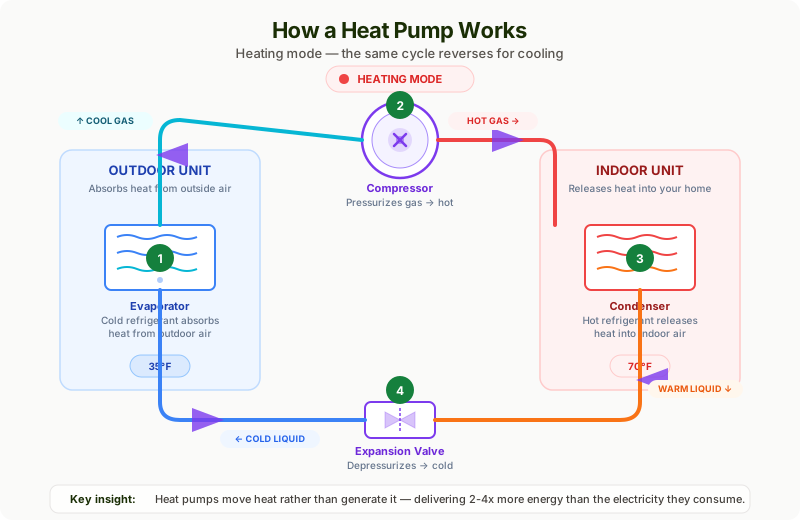
The magic behind a heat pump is the refrigerant cycle — a continuous loop of four stages that moves heat from where you do not want it to where you do.
- Compression — Low-pressure refrigerant gas enters the compressor, which squeezes it to increase both pressure and temperature. The gas becomes superheated — much hotter than the air inside your home.
- Condensation — The superheated gas flows through the condenser coil (inside your home during heating mode). Because the gas is hotter than your indoor air, heat naturally flows out of the refrigerant and into your home. As the gas releases heat, it cools and condenses into a liquid.
- Expansion — The liquid refrigerant passes through an expansion valve, which drops the pressure dramatically. This causes a sharp temperature drop — the refrigerant becomes much colder than the outdoor air.
- Evaporation — The cold refrigerant passes through the evaporator coil (outside your home during heating mode). Because it's colder than the outdoor air, heat flows from the air into the refrigerant, causing it to evaporate back into a gas. The cycle starts over.
A switching device called a reversing valve flips the direction of the refrigerant flow, allowing the system to switch between heating and cooling modes. This is why a single heat pump replaces both a furnace and an air conditioner.
Why Heat Pumps Are So Efficient
Because a heat pump moves heat rather than creating it through combustion or electric resistance, it can deliver two to four times more heating energy than the electricity it consumes. Engineers measure this with a number called the Coefficient of Performance (COP). A COP of 3.0 means for every one kilowatt-hour of electricity the system uses, it delivers three kilowatt-hours of heat into your home.
Compare that to the alternatives:
- Gas furnace: 0.95 COP at best (95 percent AFUE efficiency)
- Electric baseboard heaters: 1.0 COP (100 percent efficiency — every watt becomes heat, but that's the ceiling)
- Heat pump: 2.0 to 4.0 COP (200 to 400 percent effective efficiency)
Think of it like a refrigerator running in reverse. Your fridge pulls heat out of a cold box and dumps it into your kitchen. A heat pump pulls heat out of cold outdoor air and dumps it into your living room. Even at 20 degrees Fahrenheit, there is still thermal energy in the air that a heat pump can capture.
Types of Heat Pumps
Not all heat pumps are the same. There are four main categories, and the right one depends on your home, climate, and budget.
Air-Source Heat Pumps (Ducted)
This is the most common type for whole-home heating and cooling. A ducted air-source heat pump looks and installs much like a central air conditioner — there is an outdoor unit connected to indoor ductwork that distributes conditioned air throughout the house. If your home already has ducts from a furnace or existing AC system, a ducted heat pump is often the simplest and most cost-effective upgrade.
Modern ducted systems use variable-speed (inverter) compressors that ramp up and down to match demand, rather than cycling on and off like older equipment. This means more consistent temperatures, quieter operation, and better efficiency.
Cost: $4,500 to $25,000 installed, with a national average of $14,529 before incentives (EnergySage 2026 data).
Best for: Homes with existing ductwork in moderate to cold climates. This is the sweet spot for most homeowners.
Ductless Mini-Splits
Mini-splits are air-source heat pumps that skip the ductwork entirely. An outdoor compressor connects via small refrigerant lines to one or more wall-mounted indoor units, each of which heats or cools a specific room or zone. You can install a single-zone system for a problem room (an addition that is always too hot, a garage workshop, a bonus room over the garage) or a multi-zone system that handles your entire home.
The big advantages are zoning flexibility and no duct losses. Traditional duct systems can waste 20 to 30 percent of your heating and cooling energy through leaks and uninsulated runs. Mini-splits eliminate that entirely. They are also ideal for older homes without existing ductwork, where adding ducts would cost $5,000 to $15,000 or more.
Cost: $2,000 to $7,000 per zone for single-zone systems. Whole-home multi-zone systems average $25,957 before incentives.
Best for: Homes without existing ductwork, room additions, or homeowners who want room-by-room temperature control. MRCOOL DIY mini-splits are designed for homeowner installation, which can save thousands on labor.
Ground-Source (Geothermal) Heat Pumps
Instead of pulling heat from the outdoor air, geothermal systems tap into the constant temperature of the earth. A few feet underground, the soil stays around 50 to 55 degrees Fahrenheit year-round, regardless of what is happening on the surface. Geothermal heat pumps circulate fluid through underground loops — either horizontal trenches or vertical boreholes — to exchange heat with the ground.
The result is the most efficient heat pump type available, with COP ratings of 3.5 to 5.0 and energy consumption 44 percent less than air-source and 72 percent less than electric resistance heating. Geothermal systems also last longer — 25 or more years for the heat pump unit and 50 or more years for the underground loops, since they have no moving parts and are protected from weather.
The tradeoff is a significantly higher upfront cost ($15,000 to $35,000 or more) and the need for adequate yard space. Installation takes two to four weeks due to the excavation required for the loop field. However, the federal geothermal tax credit (Section 25D) still covers 30 percent of the total project cost with no cap through 2032 — making it the most valuable federal incentive available for any heat pump type.
Best for: Long-term homeowners with adequate yard space and extreme climates. For a deeper dive, see our complete geothermal heat pump guide.
Heat Pump Water Heaters
Heat pump technology is not limited to space heating. Heat pump water heaters work on the same principle — they pull heat from the surrounding air and use it to heat your water. According to the Department of Energy, they are two to three times more efficient than conventional electric resistance water heaters.
An ENERGY STAR certified heat pump water heater can save a household of four approximately $550 per year compared to a standard electric water heater, adding up to over $5,600 in savings over the unit's lifetime. They cost $1,500 to $5,000 installed and typically pay for themselves within three to seven years.
The main requirements are a location with ambient temperatures between 40 and 90 degrees Fahrenheit and at least 1,000 cubic feet of surrounding air space. For more details, see our guide on whether heat pump water heaters are worth it and our roundup of the best heat pump water heaters in 2026.
Decision Matrix: Which Type to Choose
| Your Situation | Recommended Type | Why |
|---|---|---|
| Existing ductwork, moderate climate | Air-source (ducted) | Most practical option, lowest cost |
| No existing ductwork | Mini-split | Avoids $5,000–$15,000 duct installation cost |
| Extreme cold climate | Cold-climate air-source or geothermal | Designed for sub-zero performance |
| Room addition or garage conversion | Mini-split (single zone) | Minimal disruption, $2,000–$7,000 |
| Long-term homeowner with yard space | Geothermal | Best ROI over 15–25 years |
| Rental property or shorter ownership | Air-source or mini-split | Lower upfront cost, faster payback |
| Supplementing an existing system | Mini-split | Add comfort without replacing everything |
| Replacing electric resistance heating | Any type | Strongest ROI, 3–7 year payback |
Efficiency Ratings Explained: SEER2 and HSPF2
Heat pump efficiency is measured by two numbers, and understanding them helps you compare models and avoid overpaying for features you do not need.
SEER2: Cooling Efficiency
SEER2 (Seasonal Energy Efficiency Ratio 2) measures cooling output in BTUs divided by electricity consumed during a typical cooling season. Higher is better.
Federal minimums (since 2023):
- Northern states: 13.4 SEER2
- Southern/Southeast/Southwest: 14.3 SEER2
Efficiency tiers:
| Tier | SEER2 Range | What It Means |
|---|---|---|
| Good | 13.4–15.1 | Meets code, basic savings |
| High-efficiency | 15.2–17 | Meaningful bill reduction |
| Premium | 17+ | Maximum cooling savings |
| Top of market | 28 (Lennox SL28XCV) | Highest residential rating in 2026 |
HSPF2: Heating Efficiency
HSPF2 (Heating Seasonal Performance Factor 2) measures heating output divided by electricity consumed during a typical heating season. Again, higher is better.
Federal minimums:
- Split systems: 7.5 HSPF2
- Packaged systems: 6.7 HSPF2
Efficiency tiers:
| Tier | HSPF2 Range | What It Means |
|---|---|---|
| Standard | 7.5–8.5 | Meets code |
| High-efficiency | 9–11 | Strong heating performance |
| Premium | 12+ | Best-in-class heating efficiency |
What Changed with SEER2 and HSPF2
The "2" versions use the M2 test procedure, which simulates real-world installation conditions (including duct resistance) rather than idealized lab setups. The numbers come out approximately 15 percent lower for the same equipment. A unit rated 16 SEER under the old system might rate about 15 SEER2 under the new system — same equipment, harder test. Do not compare old SEER ratings directly to SEER2 ratings.
What to Look For
At a minimum, look for ENERGY STAR certification. For meaningful energy savings, target SEER2 of 16 or higher and HSPF2 of 9 or higher. If you live in a cold climate, insist on ENERGY STAR Cold Climate certification (Version 6.2, effective January 2025), which requires a COP of at least 1.75 at 5 degrees Fahrenheit and at least 70 percent of rated heating capacity at that temperature.
Do Heat Pumps Work in Cold Climates?
This is the question that held back heat pump adoption for decades, and the answer has changed dramatically. Modern cold-climate heat pumps are engineered specifically for harsh winters, and they deliver.
The DOE Cold Climate Heat Pump Challenge
The Department of Energy's Cold Climate Heat Pump Challenge brought together eight major manufacturers — Bosch, Carrier, Daikin, Johnson Controls, Lennox, Midea, Rheem, and Trane Technologies — to develop systems that work efficiently well below freezing. The systems were tested at 23 sites across 10 US states and 2 Canadian provinces, providing real-world validation rather than just lab results.
The result is a new generation of cold-climate heat pumps tested at temperatures as low as negative 15 degrees Fahrenheit that still deliver meaningful heating output.
ENERGY STAR Cold Climate Certification (Version 6.2)
To earn the ENERGY STAR Cold Climate certification (updated January 2025), a heat pump must:
- Deliver a COP of at least 1.75 at 5 degrees Fahrenheit
- Maintain at least 70 percent of its rated heating capacity at 5 degrees Fahrenheit compared to 47 degrees Fahrenheit
At 5 degrees Fahrenheit, quality cold-climate heat pumps operate at a COP of 2.2 to 2.8, meaning they still produce more than twice as much heat as the electricity they consume. Even at those extreme temperatures, they outperform electric resistance heating by a factor of two or more.
The Technology Behind Cold-Climate Performance
Three key advances make modern cold-climate performance possible:
- Variable-speed inverter compressors adjust output continuously rather than cycling on and off. This prevents the efficiency drops that plagued older single-speed systems in cold weather.
- Vapor injection technology boosts heating capacity in extreme cold by injecting additional refrigerant into the compression cycle at a critical point.
- New low-GWP refrigerants like R-454B perform better across a wider temperature range while having 75 percent lower global warming potential than the R-410A they replace.
Climate Zone Quick Guide
| Climate | Typical Winter Lows | Recommendation | Notes |
|---|---|---|---|
| Hot/humid (FL, TX, AZ) | Above 35°F | Any air-source heat pump | Strongest cooling savings |
| Mixed/moderate (NC, TN, MO) | 15–30°F | Standard or cold-climate air-source | Sweet spot for heat pump ROI |
| Cold (NY, IL, CO) | 0–15°F | Cold-climate air-source or dual-fuel | Backup may be needed below 10–20°F |
| Very cold (MN, WI, ME) | Below 0°F | Cold-climate air-source or geothermal | ccASHP works to -15°F; geothermal is unaffected by air temp |
If you live in a cold climate, the Northeast Energy Efficiency Partnerships (NEEP) maintains a searchable list of certified cold-climate heat pumps that is worth bookmarking. Also check out our picks for the best heat pumps for home in 2026, which includes our top cold-climate recommendations.
Where You Might Still Need Backup
In very cold climates where temperatures regularly drop below 10 degrees Fahrenheit, a dual-fuel (hybrid) system pairs a heat pump with a gas furnace backup. The heat pump handles most of the heating load efficiently, and the gas furnace kicks in only during the coldest snaps. These hybrid systems average $14,353 installed and give you the best of both worlds.
If your home is older and poorly insulated, address insulation first before installing any heat pump. A heat pump in a drafty house will run constantly and may not keep up. Start with air sealing and check our guides on insulation types and attic insulation.
How Much Does a Heat Pump Cost in 2026?
Cost is usually the first question, and the honest answer is "it depends." But here are real numbers from 2026 installation data.
The national average for a fully installed heat pump system is around $15,393 before incentives. After available rebates, that drops to roughly $14,153. But costs vary widely based on system type, home size, and where you live.
Cost by System Type
| System Type | Low End | Average | High End |
|---|---|---|---|
| Air-source (ducted) | $4,500 | $7,500–$14,500 | $25,000 |
| Mini-split (single zone) | $2,000 | $3,000–$5,000 | $7,000 |
| Mini-split (multi-zone, whole home) | $10,000 | $20,000–$26,000 | $35,000+ |
| Geothermal | $15,000 | $20,000–$30,000 | $35,000+ |
| Hybrid (heat pump + furnace) | $8,000 | $14,353 | $20,000+ |
| Heat pump water heater | $1,500 | $2,500–$3,500 | $5,000 |
How Location Affects Price
Regional cost differences are dramatic:
| Region | Average Installed Cost |
|---|---|
| New Mexico (lowest) | ~$8,000 |
| Florida | ~$10,340 |
| Massachusetts | ~$24,482 |
| New York (highest) | ~$33,000 |
Local labor rates, permit requirements, and the complexity of your installation all play a role. Cold-climate states tend to have higher costs because contractors install cold-climate rated equipment (which costs more) and local building codes may be stricter.
What Drives Cost Variation
- System size (tons/BTU): A 2-ton system is much cheaper than a 5-ton system
- Efficiency level: Higher SEER2/HSPF2 ratings mean higher equipment cost but lower operating cost over time
- Ductwork condition: Sealing, insulating, or replacing ducts adds $1,000 to $5,000 or more
- Electrical upgrades: You may need a panel upgrade or new circuit ($500 to $2,000)
- Labor rates: Vary significantly by region
- Brand tier: Budget brands run $4,000 to $7,000; mid-range $6,000 to $11,000; premium $8,000 to $15,000 or more
The R-454B Refrigerant Transition
As of January 2025, all newly manufactured HVAC systems use R-454B refrigerant instead of R-410A. As of January 2026, all new split systems must use a refrigerant with a global warming potential (GWP) below 700. R-454B has a GWP of 466, compared to R-410A's 2,088 — a 75 percent reduction.
What this means for your wallet:
- Equipment costs are 8 to 10 percent higher due to redesigned components, built-in leak detection sensors, and new safety certifications
- R-454B systems are slightly more energy efficient than their R-410A predecessors
- Major manufacturers have adopted R-454B as the standard: Carrier, Trane, Lennox, and York/Johnson Controls all ship R-454B systems
- Existing R-410A systems are fine to keep and service — R-410A refrigerant is still available for maintenance and repairs
- Some rebate programs now exclude R-410A equipment — Mass Save in Massachusetts, for example, no longer qualifies R-410A systems starting in 2026
If you are buying a new system, you will get R-454B regardless. The price premium is already baked into the 2026 cost numbers above.
How This Compares to a Furnace and AC
Here is the number that matters most: a ducted heat pump after incentives costs roughly $13,527, while a new gas furnace plus central air conditioner together run $11,590 to $14,100. That makes heat pumps essentially price-competitive with the traditional setup in 2026 — before you factor in lower operating costs.
Energy Savings and ROI
The upfront cost comparison only tells half the story. Where heat pumps really shine is in monthly operating costs and long-term return on investment.
Operating Cost Savings
In moderate climates, homeowners switching from a gas furnace and central AC to a heat pump can expect to save 30 to 50 percent on heating and cooling costs. Over 10 years, that translates to roughly $8,500 in savings compared to running separate heating and cooling systems.
Monthly operating costs:
| System Type | Monthly Heating/Cooling Cost |
|---|---|
| Heat pump | $40–$160 |
| Traditional furnace + AC | $80–$200 |
These savings exist because a heat pump replaces two separate appliances with one system that is dramatically more efficient at both jobs. Instead of burning gas at 95 percent efficiency or running electric resistance heat at 100 percent efficiency, a heat pump delivers 200 to 400 percent efficiency by moving existing heat rather than creating it.
Payback Period by Replacement Scenario
Your return on investment depends heavily on what you are replacing:
| What You Are Replacing | Typical Payback | Why |
|---|---|---|
| Electric resistance heating (baseboard, wall units) | 3–7 years | Strongest ROI — heat pumps use 2.5–4.5x less energy |
| Oil furnace/boiler | 4–8 years | Oil prices volatile, generally higher than electricity |
| Propane furnace | 5–10 years | Propane typically more expensive than natural gas |
| Natural gas furnace (moderate climate) | 7–12 years | Depends heavily on gas vs. electricity prices |
| Natural gas furnace (cold climate) | 10–20 years | Longest payback; dual-fuel may be better |
| Geothermal (any replacement) | 5–10 years | Higher upfront but lowest operating cost |
The savings are largest in areas with moderate climates and high electricity-to-gas price ratios. If your electricity is relatively cheap, check your state electricity rate guide for context.
Home Value Impact
Heat pumps add measurable resale value:
- Air-source heat pumps: $4,000 to $8,000 added to home value
- Geothermal systems: $10,000 to $20,000 added to home value
- ENERGY STAR equipment is increasingly expected by homebuyers, particularly in energy-conscious markets
System Lifespan
- Air-source heat pumps: 15 to 20 years with proper maintenance (can reach 20 or more years with exceptional care)
- Geothermal systems: 25 or more years for the heat pump unit; ground loops last 50 or more years
- Compared to furnaces (15 to 20 years) and AC units (10 to 15 years), a heat pump replaces both with comparable or longer lifespan
For homeowners already considering other energy upgrades, pairing a heat pump with solar panels can dramatically reduce or eliminate your heating and cooling costs entirely. See our breakdown of the real cost of installing solar panels at home to explore that combination, or read our whole-home electrification guide for the full roadmap.
Heat Pump Incentives and Rebates in 2026
The incentive landscape changed significantly after the One Big Beautiful Bill Act (OBBBA) was signed into law in late 2025. Here is what you need to know.
Federal Tax Credits: What Changed
The Section 25C Energy Efficient Home Improvement Credit, which previously offered up to $2,000 per year for qualifying heat pump installations, expired on December 31, 2025. If you install an air-source heat pump in 2026, this credit no longer applies. You can still claim it on your 2025 tax return for installations completed by December 31, 2025.
Geothermal Tax Credit: Still Active (Section 25D)
The federal geothermal tax credit remains active through 2032 and is the most valuable heat pump incentive available:
- 30 percent of total project cost with no cap
- Covers equipment, labor, and ground loop installation
- On a $25,000 geothermal installation, that is a $7,500 credit
- This is significantly more valuable than the expired 25C credit ever was
If you are considering a geothermal heat pump, this credit alone can shift the economics dramatically.
Federal Rebate Programs Still Available
Two IRA-funded rebate programs remain active with a combined $8.8 billion in funding through 2031:
- HEAR (Home Electrification and Appliance Rebates): Up to $8,000 for households earning 80 percent or less of area median income (AMI); up to $4,000 for households at 80 to 150 percent AMI. Applied at point of purchase — immediate savings, not a tax return credit.
- HOMES (Home Owner Managing Energy Savings): Rebates based on measured whole-home energy savings, available to all income levels. Can be combined with HEAR in many states.
Important: State rollout timelines and funding status vary. California's single-family HEAR program was fully reserved as of February 2026 (waitlist only), while Washington and Colorado programs remain open. Check switchison.org or rewiringamerica.org for your state's status.
Total Potential Savings Examples
Low-income household ($10,000 air-source installation):
- HEAR rebate: up to $8,000
- Utility rebate: $500–$1,500
- Total out-of-pocket: as low as $500–$1,500
Moderate-income household without HEAR ($10,000 air-source):
- No federal tax credit (25C expired)
- State/utility rebates: $500–$2,000
- Total out-of-pocket: $8,000–$9,500
Geothermal installation ($25,000):
- 25D tax credit (30%, no cap): $7,500
- State/utility rebates: $1,000–$3,000
- Total out-of-pocket: $14,500–$16,500
State and Utility Rebates
State programs have become the primary source of heat pump incentives in 2026. Some of the most generous include:
- Massachusetts (Mass Save): Up to $8,500 for qualifying whole-home heat pump installations
- Rhode Island (Clean Heat RI): Up to $11,500
- New Jersey (Whole Home): Up to $7,500
Many local utilities also offer their own rebates on top of state programs, typically $300 to $2,000 for qualifying installations. Contact your electric utility directly or search the DSIRE database for current heat pump incentives in your area.
For a broader overview of clean energy incentives, check out our guide on solar incentives and tax credits in 2026, which covers the post-OBBBA landscape in detail. You can also read our complete guide to IRA clean energy tax credits for the full picture, or see our guide on how to stack energy rebates and incentives to maximize your savings.
Top Heat Pump Brands in 2026
Not all heat pumps are created equal. Here are the brands that consistently earn top marks from industry experts and consumers, organized by price tier.
Premium Tier
| Brand | Standout Model | Max SEER2 | Max HSPF2 | Installed Cost | Key Strength |
|---|---|---|---|---|---|
| Lennox | SL28XCV | 28 | 12+ | $8,000–$14,000 | Highest residential efficiency rating |
| Carrier | Infinity 24 with Greenspeed | 24 | 13 | $8,000–$15,000 | Variable-speed, smart home integration |
| Trane | XV20i TruComfort | 21 | 10+ | $7,500–$13,000 | Ultra-quiet, humidity control |
| Mitsubishi | Hyper-Heating H2i | 23 | 12 | $7,000–$13,000 | Best cold-climate ductless performance |
Lennox has earned repeated ENERGY STAR Most Efficient awards. Their SL28XCV achieves the highest residential efficiency rating available in 2026 and is designed for the R-454B refrigerant. If maximum efficiency is your priority, Lennox is worth a close look.
Carrier's Infinity line with Greenspeed Intelligence offers proven performance in both extreme heat and extreme cold. Their strong dealer network means you are unlikely to have trouble finding a qualified installer or getting warranty service.
Mitsubishi remains the gold standard in the ductless and mini-split market. Their Hyper-Heating H2i line is specifically engineered for cold climates, with models rated to operate at full capacity down to extreme low temperatures. If you are going ductless in a cold climate, Mitsubishi is the benchmark. For detailed model comparisons, see our best heat pumps for home in 2026 roundup.
Mid-Range Tier
| Brand | Installed Cost | Key Strengths |
|---|---|---|
| Bosch | $6,000–$10,000 | Quiet operation (~56 dB), competitive pricing |
| Daikin | $6,000–$11,000 | Global leader, under 2% five-year failure rate |
| Fujitsu | $5,000–$9,000 | Reliable ductless lineup |
| LG | $5,000–$9,000 | Innovation, smart features |
Daikin deserves special mention. As the parent company of Goodman and Amana, Daikin now influences nearly 40 percent of the U.S. residential HVAC market. Their inverter-driven systems are known for quiet operation, excellent multi-zone performance, and industry-leading reliability — consistently ranking below 2 percent field failure rate over five years.
Bosch has earned a growing reputation in the ductless market by delivering inverter performance at a competitive price point. Their systems are notably quiet and offer solid efficiency without the premium pricing.
Value Tier
| Brand | Installed Cost | Key Strengths |
|---|---|---|
| Rheem | $4,500–$8,000 | Good balance of cost and quality |
| Goodman | $4,000–$7,000 | Budget-friendly with solid warranties (Daikin-owned) |
| MRCOOL | $2,000–$5,000 | DIY-friendly mini-splits, pre-charged lines |
MRCOOL is the standout in the value tier. Their DIY mini-split line is designed for homeowner installation with pre-charged refrigerant lines, which can save thousands on labor costs. They are the bestselling ductless brand on Amazon and a strong choice if you are comfortable with a DIY installation.
Reliability Rankings
- Daikin and Mitsubishi Electric consistently rank highest in reliability surveys, with field failure rates below 2 percent over five years
- Carrier, Lennox, and Trane account for more than half of heat pumps chosen by consumers
- Consumer Reports ranks Lennox among the most reliable brands overall
- All major brands participated in the DOE Cold Climate Heat Pump Challenge
For any heat pump purchase, we recommend getting quotes from at least three local HVAC contractors. Services like EnergySage can connect you with vetted installers in your area and help you compare pricing.
Sizing Your Heat Pump: Why Manual J Matters
Getting the right size heat pump is the single most important factor in system performance. An oversized system will short-cycle (turning on and off frequently), leading to higher bills, more wear, and poor humidity control. An undersized system will not keep up in extreme weather and will run constantly.
Why Rules of Thumb Fail
Many contractors use quick estimates based on square footage (20 to 60 BTU per square foot depending on climate and insulation). Studies show the closest rule-of-thumb estimate was still off by 12,000 BTUs — enough to select the wrong equipment entirely.
What a Manual J Load Calculation Does
Manual J is the industry-standard method for determining your home's actual heating and cooling requirements. It accounts for:
- Building geometry and orientation
- Insulation levels in walls, ceilings, and floors
- Window performance (type, size, direction they face)
- Air leakage rates
- Occupancy and internal heat gains
- Local climate data
A proper Manual J takes 1 to 2 hours and is the foundation for correct equipment selection (Manual S) and duct design (Manual D).
What to Insist On
- Always require a Manual J load calculation from your contractor. This is non-negotiable.
- A blower door test helps quantify air leakage and improves the accuracy of the calculation.
- Red flag: Any contractor who sizes your system based only on square footage without performing a Manual J calculation is cutting corners. Get a different contractor.
Installation Process: What to Expect
Timeline
- Home evaluation (1–2 hours): Contractor performs Manual J load calculation, inspects ductwork, checks electrical capacity, and assesses insulation
- Proposal and scheduling (1–2 weeks): Get two to three quotes minimum; confirm permits are included
- Installation (1–2 days standard; add 2–4 days if new ductwork is needed):
- Remove old equipment safely
- Set outdoor unit on a level pad with proper clearance
- Install or connect indoor air handler or wall units
- Run refrigerant lines and electrical connections
- Vacuum the system, charge refrigerant, and test thoroughly
- Inspection (varies by jurisdiction): Electrical and/or HVAC permit inspection required in most areas
Red Flags When Hiring a Contractor
Walk away from any contractor who:
- Sizes the system based only on square footage without a Manual J calculation
- Provides only one quote or pressures you for an immediate decision
- Does not discuss ductwork condition or air sealing opportunities
- Does not mention permits or inspections
- Is not NATE-certified or properly licensed for your state
- Is unwilling to provide references or show proof of insurance
Maintenance: Protecting Your Investment
Heat pumps run year-round (heating in winter, cooling in summer), which means they need maintenance twice a year — once in spring before cooling season and once in fall before heating season. This is more frequent than a furnace (once per year) because the system never gets a break.
Professional Maintenance Costs
| Service | Cost |
|---|---|
| Annual maintenance plan (two tune-ups, priority service, repair discounts) | $120–$360/year |
| Individual tune-up visit | $70–$200 |
| Average repair | $150–$600 |
| Major repair (compressor, coil replacement) | $1,000–$3,000 |
What Professionals Check
During a tune-up, your technician should check:
- Refrigerant charge level
- Indoor and outdoor coil condition (cleaning as needed)
- Blower wheel inspection
- Static pressure test
- Electrical connections
- Defrost function (critical for cold-climate performance)
- Control and thermostat calibration
DIY Maintenance Tasks
Between professional visits, you can keep your system running efficiently with these tasks:
- Change or clean filters monthly — this is the single most important DIY maintenance task
- Keep the outdoor unit clear of debris, leaves, and snow (maintain at least 2 feet of clearance)
- Check for ice buildup on the outdoor unit in winter
- Keep indoor vents unobstructed by furniture or curtains
- Listen for unusual noises and report them to your technician
Why Maintenance Matters
Proper maintenance adds 5 to 10 years to your system's lifespan. Clean airflow and proper refrigerant charge protect the compressor — the single most expensive component. A well-maintained system maintains its rated efficiency; a neglected one can lose 10 to 25 percent efficiency over time. Skipping maintenance is a leading cause of premature heat pump failure.
Pairing your heat pump with the right thermostat maximizes performance. See our guide on the best smart thermostats for heat pumps for compatible models that optimize heat pump cycling and scheduling.
When Does a Heat Pump Make Sense?
Heat pumps are the right choice for most homeowners in most situations, but they are not universally the best option.
Heat Pumps Are a Great Fit If:
- You need to replace an aging furnace or AC. If either system is near the end of its life, replacing both with a single heat pump is often cheaper than buying a new furnace and a new AC separately.
- You live in a moderate climate (zones 3 through 5). This is the sweet spot with the highest savings potential.
- You live in a cold climate and choose a cold-climate model. Modern ccASHP units work well even in Minnesota and Maine winters.
- Your home is reasonably well insulated. Heat pumps perform best in homes that do not leak energy through drafty walls and attics. Start with air sealing if your home is drafty.
- You are replacing electric resistance heating. This is the strongest ROI scenario, with payback as fast as 3 years.
- You want to reduce your carbon footprint. Heat pumps produce zero direct emissions and become even cleaner as the grid adds more renewable energy. Learn more about how renewable energy works and why it matters.
- You are considering whole-home electrification. A heat pump is typically the single biggest step in going all-electric.
Think Twice If:
- Your home is poorly insulated. A heat pump in a drafty house will run constantly and may not keep up. Address insulation first.
- Natural gas is extremely cheap in your area. If gas costs less than about $1 per therm and your winters are mild, the payback period extends significantly.
- Your home needs major electrical upgrades. Some older homes have 100-amp panels that will not support a heat pump without an expensive electrical panel upgrade. Get an electrician's assessment before committing.
- You are in a rental. Unless your landlord is willing to invest, a heat pump is a major permanent installation.
- The installation is unusually complex. Homes with no ductwork, limited outdoor space, or challenging layouts can push installation costs well above average.
- You are selling within 2 to 3 years. Payback may not be fully realized, though the $4,000 to $8,000 home value increase offsets some of the cost.
Frequently Asked Questions
How long does a heat pump last? Air-source heat pumps typically last 15 to 20 years with proper maintenance. Geothermal systems last 25 or more years, and their ground loops can last 50 or more years. Proper twice-yearly maintenance can add 5 to 10 years to the lifespan.
Are heat pumps loud? Modern variable-speed heat pumps are remarkably quiet. Most premium and mid-range outdoor units operate at 55 to 65 decibels — about the volume of a normal conversation. Indoor ductless units are even quieter, often below 30 decibels. Brands like Bosch and Trane are known for particularly quiet operation.
Can I install a heat pump myself? For most systems, professional installation is required — it involves refrigerant handling, electrical work, and permitting. The exception is MRCOOL DIY mini-splits, which are specifically designed for homeowner installation with pre-charged refrigerant lines. You will still need an electrician for the dedicated circuit.
What happens to my existing furnace? You have two options. A full replacement removes the furnace entirely and the heat pump handles all heating and cooling. A dual-fuel (hybrid) setup keeps your gas furnace as backup for extreme cold snaps while the heat pump handles 80 to 90 percent of the heating load. Hybrid systems average $14,353 installed.
Do I need to replace my ductwork? Not necessarily. If your existing ducts are in good condition and properly sized, a heat pump can use them directly. However, leaky or undersized ducts should be sealed or replaced, which adds $1,000 to $5,000 to the project. Your contractor's Manual J assessment will identify any ductwork issues.
Is R-454B refrigerant safe? Yes. R-454B is classified as mildly flammable (A2L), but all systems using it include built-in leak detection sensors and are designed to meet strict safety standards. The risk to homeowners is extremely low. The environmental benefit is significant — 75 percent lower global warming potential than R-410A.
What if I lose power? Like any electric heating system, a heat pump will not operate during a power outage. If outages are common in your area, consider pairing your heat pump with a home battery backup system or a portable generator. A dual-fuel system with a gas furnace provides backup heating during outages if the furnace has a direct-vent design.
Can I pair a heat pump with solar panels? Absolutely — this is one of the best combinations for energy independence. Solar panels generate the electricity your heat pump uses, potentially reducing your heating and cooling costs to near zero. See our guide on the real cost of installing solar panels and our whole-home electrification step-by-step guide.
Making the Decision: Your Action Plan
Still not sure? Follow this step-by-step process.
- Get your current energy costs. Pull 12 months of gas and electric bills. Add up what you spend on heating and cooling specifically. Use a home energy monitor if you want precise breakdowns.
- Assess your home's readiness. Check insulation quality and electrical panel capacity. If your home is drafty, start with air sealing and weatherization — it will improve the performance of any heating system. A DIY home energy audit can identify the biggest opportunities.
- Get three quotes. Contact local HVAC contractors for heat pump installation quotes. Insist on Manual J load calculations. Make sure at least one quote includes a cold-climate model if you are in climate zones 5 or above.
- Check incentives. Look up state rebates, utility programs, and whether HEAR/HOMES funds are available in your state at switchison.org. For geothermal, calculate your 30 percent Section 25D credit. Learn how to stack rebates and incentives for maximum savings.
- Run the payback math. Take the net installation cost (after incentives) and divide it by your estimated annual savings. If the payback is under 10 years, the heat pump is almost certainly worth it.
- Consider the full picture. A heat pump also adds AC if you do not already have it, eliminates combustion risks (carbon monoxide, gas leaks), increases your home's resale value by $4,000 to $8,000, and positions your home for whole-home electrification down the road.
The Bottom Line
Heat pumps have moved from niche technology to mainstream default. In 2026, they are price-competitive with traditional furnace-and-AC setups, dramatically more efficient, and capable of handling even the coldest climates. The loss of the 25C federal tax credit under the OBBBA is a setback, but the geothermal 25D credit (30 percent, no cap, through 2032) remains powerful, and generous state programs, utility rebates, and the HEAR/HOMES federal rebate programs help offset installation costs for many homeowners.
The technology is no longer in question. Modern cold-climate heat pumps have been tested by eight major manufacturers across 10 U.S. states and 2 Canadian provinces in the DOE Cold Climate Challenge. Variable-speed inverter compressors, vapor injection, and the new R-454B refrigerant make these systems reliable performers even at negative 15 degrees Fahrenheit.
If your furnace or AC is reaching the end of its useful life, a heat pump should be at the top of your replacement list. The upfront cost is comparable to what you would spend on separate heating and cooling equipment, and the long-term savings — 30 to 50 percent on monthly energy bills — make the math work for the vast majority of homes.
The best next step is simple: get quotes from qualified local installers, check your state and utility incentive programs, and run the numbers for your specific situation.
Installer quotes
Ready to get quotes from local installers?
Compare prices from vetted installers in your area. It takes two minutes, costs nothing, and there's no obligation to move forward.
Savings Tool
Estimate how much your electric bill could actually drop
Model a mix of efficiency upgrades, rate-plan savings, and an upfront budget so you can see what a realistic bill-reduction plan might look like before you buy equipment.
Keep learning
Get the next practical clean energy guide in your inbox
We send focused, consumer-friendly advice on costs, comparisons, and what to do next.
No spam. Unsubscribe anytime.
Reviewed By Watt Wise Editorial Team
Consumer-first efficiency guidance
The Watt Wise editorial team researches clean-energy products, costs, and incentives for everyday homeowners, renters, and EV drivers — in plain language, updated as pricing and rules change.
Focus
Costs, tradeoffs, and what to do next.
Approach
Plain language over sales copy or jargon.
Standards
Updated as pricing, incentives, and rules change.
Editorial Methodology
How this efficiency guide is maintained
Watt Wise guides are built to help readers understand real-world costs, tradeoffs, and next steps before they spend money. We update time-sensitive pages when incentives, utility rules, pricing, or product availability materially change.
What we look at
Costs, compatibility, warranties, utility rules, incentives, and where common buyer mistakes happen.
Update status
Last material update: April 6, 2026.
Next Reads
Keep the research moving
Related guide
Geothermal Heat Pumps: The Complete Guide
Geothermal heat pumps explained: how ground-source HVAC works, 2026 installation costs, payback, and whether it is right for your home.
Related guide
Best Smart Thermostats for Heat Pumps in 2026
Find the best smart thermostat for your heat pump. Compare Ecobee, Nest, Honeywell, and Sensi on staging, aux heat control, and dual fuel support.
Related guide
How to Install a Smart Thermostat (DIY Guide)
A complete DIY guide to installing a smart thermostat. Covers wiring, C-wire solutions, heat pump setup, common mistakes, and when to call a professional.